


News and Updates
Partnerships, trade shows, new systems, and updates from the world of industrial metrology.
Everything happening at Measure 3D and in the industries we serve.
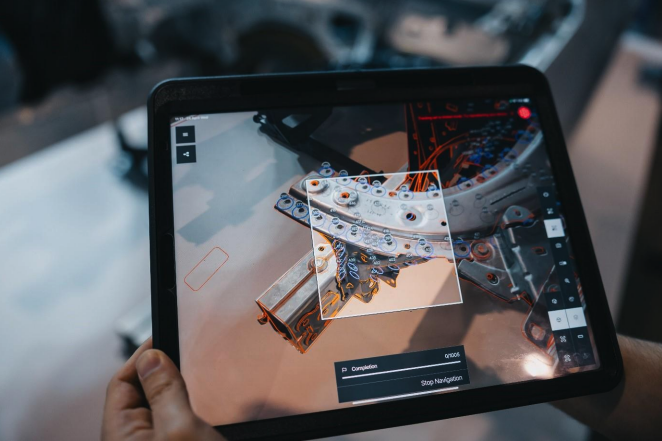
SuPAR AI: Augmented Reality Meets Artificial Intelligence
Augmented Reality and Artificial Intelligence
We are thrilled with the initial success of the launch of SuPAR AI, an additional feature that further optimizes visual inspection using augmented reality. The positive response from the manufacturing sector and other industries has motivated us to continue improving and expanding SuPAR’s capabilities to enable our customers to achieve an increasingly fast and scrap-free production process.
A Leap Forward in Production Processes
SuPAR AI has not only set new standards for accuracy and efficiency in visual inspection, but has also made faster and more reliable quality control possible. Our specialized, AI-driven modules offer tailored solutions for various production needs, enabling the inspection of welds, drill holes, and the presence or absence of pins and bolts.
Tangible Benefits for Manufacturers
By integrating SuPAR AI into their quality control processes, manufacturers can achieve a perfect balance between human interaction and the capabilities of the AI model. This reduces the time and operator expertise required to perform inspections, improves accuracy, and enables more inspections to be carried out at a lower cost.
Our Vision for the Future
Our commitment to innovation and quality is evident in the ongoing development of SuPAR AI. We look forward with enthusiasm to seeing how manufacturers will continue to use SuPAR AI to enhance their production capabilities and remain competitive in a rapidly evolving market.
Stay Up to Date with Us
We invite all industry professionals to stay up to date on the latest news from SuPAR AI and discover how this tool can transform their production processes. Keep following us on LinkedIn for more updates, case studies, and success stories.
We’re ready to support our customers in this new era of visual inspection. Contact us for a demo and discover how SuPAR AI can make a difference in your production.

SuPAR AI: Augmented Reality Meets Artificial Intelligence
Augmented Reality and Artificial Intelligence
We are thrilled with the initial success of the launch of SuPAR AI, an additional feature that further optimizes visual inspection using augmented reality. The positive response from the manufacturing sector and other industries has motivated us to continue improving and expanding SuPAR’s capabilities to enable our customers to achieve an increasingly fast and scrap-free production process.
A Leap Forward in Production Processes
SuPAR AI has not only set new standards for accuracy and efficiency in visual inspection, but has also made faster and more reliable quality control possible. Our specialized, AI-driven modules offer tailored solutions for various production needs, enabling the inspection of welds, drill holes, and the presence or absence of pins and bolts.
Tangible Benefits for Manufacturers
By integrating SuPAR AI into their quality control processes, manufacturers can achieve a perfect balance between human interaction and the capabilities of the AI model. This reduces the time and operator expertise required to perform inspections, improves accuracy, and enables more inspections to be carried out at a lower cost.
Our Vision for the Future
Our commitment to innovation and quality is evident in the ongoing development of SuPAR AI. We look forward with enthusiasm to seeing how manufacturers will continue to use SuPAR AI to enhance their production capabilities and remain competitive in a rapidly evolving market.
Stay Up to Date with Us
We invite all industry professionals to stay up to date on the latest news from SuPAR AI and discover how this tool can transform their production processes. Keep following us on LinkedIn for more updates, case studies, and success stories.
We’re ready to support our customers in this new era of visual inspection. Contact us for a demo and discover how SuPAR AI can make a difference in your production.
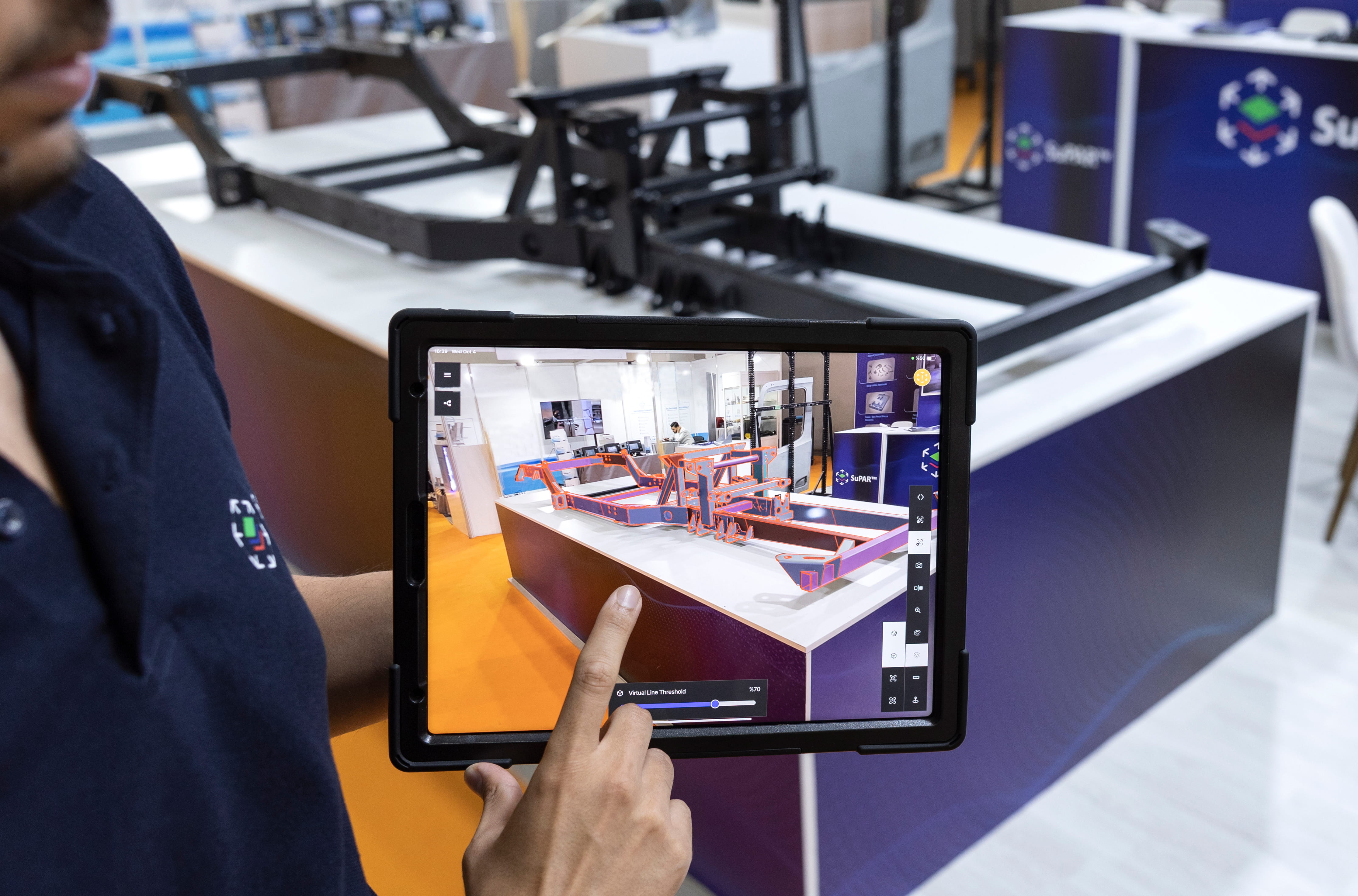
Explore the future of visual inspection with Augmented Reality: optimize your visual inspections with SuPAR™!
Measure 3D S.R.L. Official software distributor in Italy
At Measure 3D, we contribute to digital transformation and Industry 4.0 by striving to offer technologies that provide benefits to companies and their employees.
Measure 3D has been the Italian distributor of SuPAR™ augmented reality software for two years, during which time we have successfully carried out projects with international companies across various industries.
Today, Augmented Reality embodies digital transformation and delivers significant time and cost savings—up to 70%—throughout the entire production process by checking incoming materials from suppliers, verifying assembly, and identifying missing parts in a component, while linking the mathematical model to the physical part via an iPad, thereby eliminating the need for 2D drawings. This results in greater time efficiency and rapid error detection, thanks in part to user-friendly interfaces and ease of use.

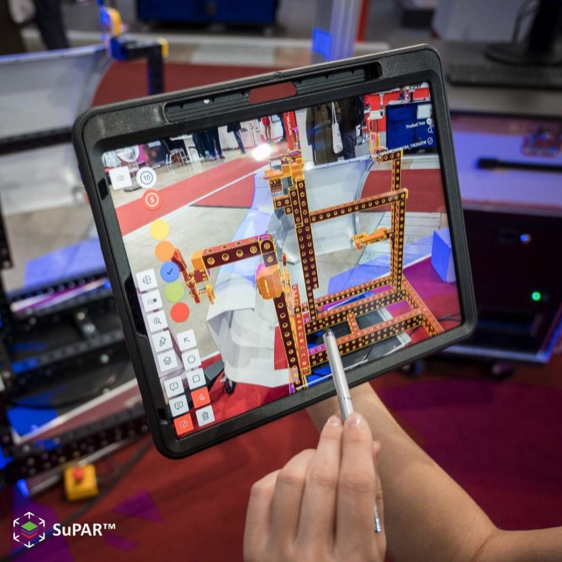
SuPAR™ in action!
Visual Inspection Using Augmented Reality: Key Benefits
- Reduced time and costs: Compared to visual inspection using 2D drawings, visual inspection with augmented reality reduces the time required by up to 90% once the CAD drawing is directly linked to the physical component. Not only does this allow you to reduce costs, but it also improves communication with customers and suppliers.
- Easy and powerful geometry compliance checking: It enables quick and immediate verification of a component or its assembly. SuPAR™ displays the edges of the CAD surface and those of the physical part, allowing for quick and easy identification of errors.
- Smart documentation, simple, guided, and customizable reporting: operators can add comments, notes, and photos during the inspection, which can be reviewed once the visual inspection is complete thanks to the immediate generation of a report in PDF, Excel, or Word format that can be shared with relevant parties.
- Physical-Digital Model with Augmented Reality: The physical-digital model simplifies assembly by displaying virtual elements on the physical component to be assembled.
- Digital Communication—Importing SME Data: Using the SME support feature, design data can be viewed during the quality control process.
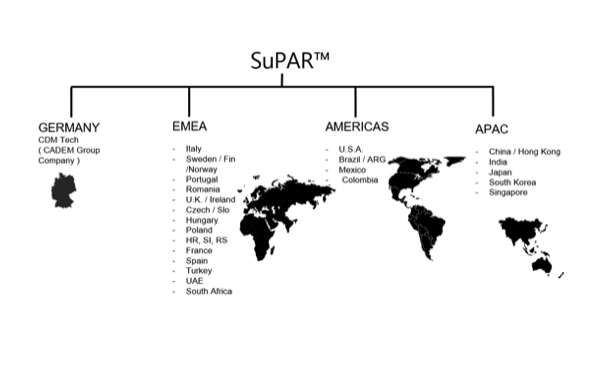
SuPAR™ Around theWorld🌏
Sales Offices Worldwide
Visit our website www.measure3d.it to learn more about SuPAR™ and contact us at info@measure3d.it to find out how it can benefit your visual inspections!
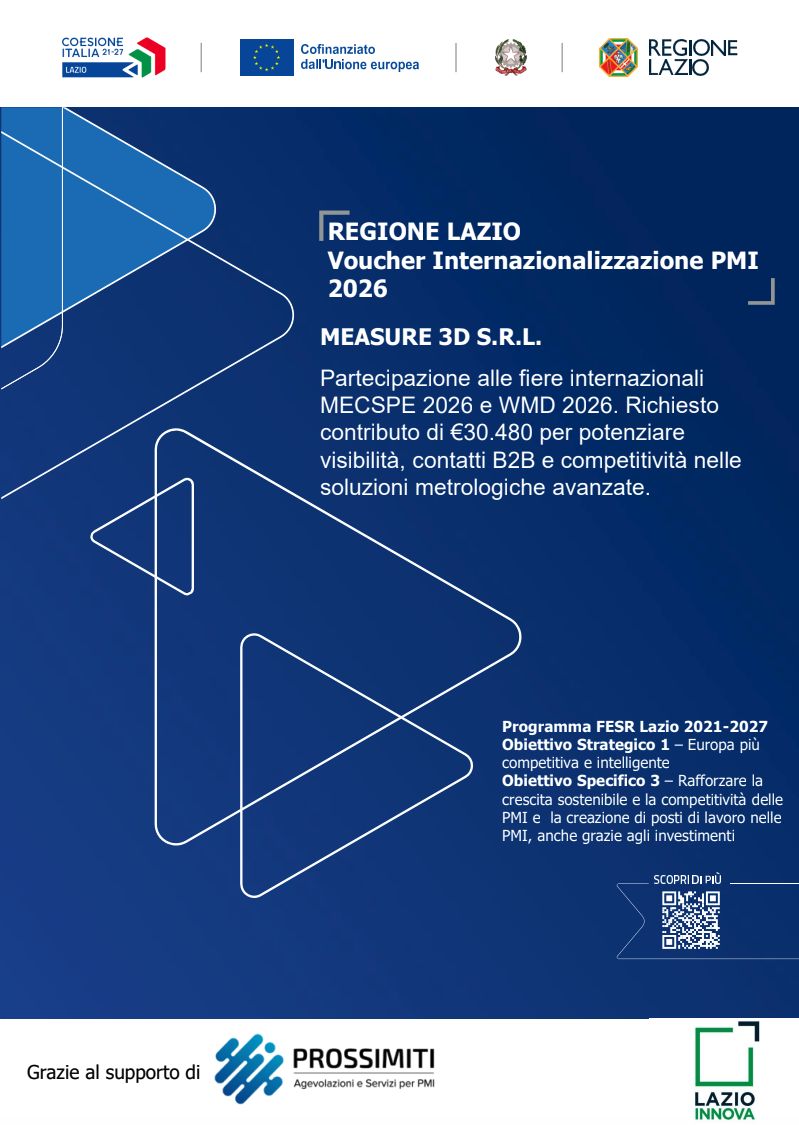
Measure 3D is at the forefront of industrial innovation through its participation in the international trade shows MECSPE 2026 and WMD 2026.
The company’s path to internationalization, made possible by the Lazio Region’s 2026 SME Internationalization Voucher.
Technological innovation and engagement with international markets are key drivers of business growth. Measure 3D S.r.l.’s participation in the 2026 SME Internationalization Voucher program, sponsored by the Lazio Region, is part of this effort. This initiative is designed to support regional SMEs in their development, international expansion, and efforts to strengthen their competitiveness.
The project is part of the 2021–2027 Lazio ERDF Program, underStrategic Objective 1—“A More Competitive and Smart Europe”— andSpecific Objective 3—“Strengthening sustainable growth and the competitiveness of SMEs and job creation in SMEs, including through investment.”
Thanks to the program's support, Measure 3D was able to participate in two major events that serve as benchmarks for the industrial and metrology sectors:
- MECSPE 2026, the international trade show dedicated to the manufacturing industry;
- WMD 2026 (World Metrology Day), an event dedicated to the fields of metrology and technological innovation.
Participating in these events provided an important opportunity to increase brand visibility, forge new professional connections, and strengthen Measure 3D’s position as a technology partner for companies seeking to improve their quality control processes through advanced solutions.
MECSPE 2026: Technology and Innovation for the Manufacturing Industry
From March 4 to 6, 2026, Measure 3D participated in MECSPE 2026 at BolognaFiere, in Hall 29—Booth D59—where it showcased its solutions for industrial metrology, 3D scanning, and digital quality control.
The event provided an important opportunity to engage with companies and professionals in the manufacturing sector, allowing Measure 3D to showcase the technologies it has developed to support businesses in their efforts to digitize and optimize production.
Among the solutions presented, SuPAR stood out in particular—an innovative software that integrates Augmented Reality and Artificial Intelligence for the visual inspection of the entire industrial production cycle.
Participation in MECSPE facilitated the establishment of new, qualified B2B contacts, direct interaction with professionals such as quality managers and production technicians, and the development of new opportunities for collaboration with companies in various industrial sectors.
WMD 2026: The Value of Metrology for the Industry of the Future
Participation in WMD 2026 represented another opportunity for growth and exchange for Measure 3D, offering the chance to highlight the role of metrology as a strategic element for industrial innovation.
The event provided an opportunity to explore the latest technological advancements in the industry, share expertise, and present solutions for measurement, 3D analysis, and the improvement of quality control processes.
Participating in this event strengthened our dialogue with a highly specialized audience and helped solidify the company’s presence in the field of Industry 4.0 technologies.
A constant commitment to innovation and international growth
Measure 3D’s participation in MECSPE 2026 and WMD 2026 confirms the growth trajectory the company has embarked upon, focused on the ongoing pursuit of innovative solutions and the development of new opportunities in domestic and international markets.
Through the Lazio Region’s 2026 SME Internationalization Voucher, the company was able to strengthen its presence in strategic markets, promote its expertise, and foster new professional relationships in the fields of advanced metrology, 3D scanning, and industrial quality control.
A path that looks toward the future of the industry, placing technology, innovation, and collaboration at the heart of the transformation of production processes.
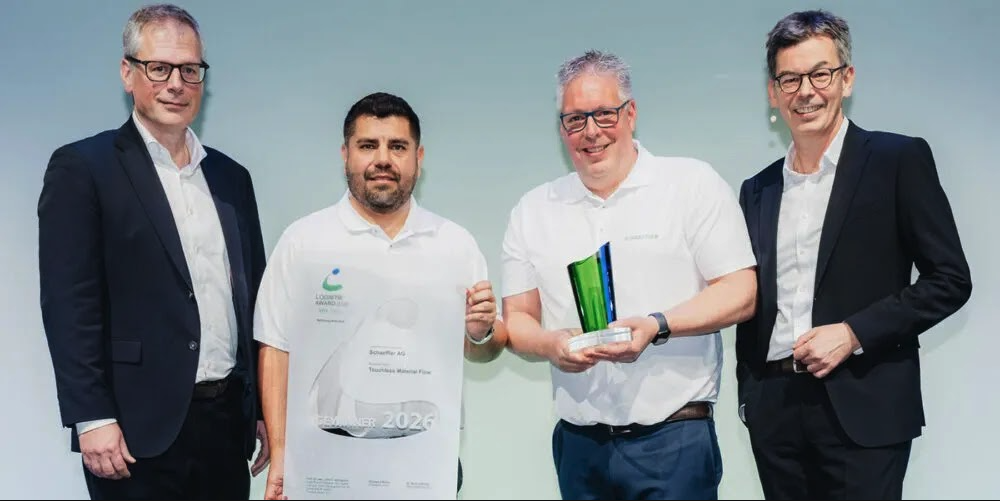
VDA Logistics Award goes to Schaeffler AG for ‘Touchless Material Flow’ concept
SuPAR replaces the previously manual and time-consuming inspection process with a significantly faster, more precise, and digitized procedure.
Jury impressed by comprehensive automation and digitalization program for largely autonomous, networked intralogistics
The prestigious Logistics Award of the German Association of the Automotive Industry (VDA) goes to Schaeffler AG this year. At the Forum Automotive Logistics (FAL) in Wolfsburg, jury chair Prof. Dr. Julia Arlinghaus presented the coveted trophy to the company, which impressed the jury with its ‘Touchless Material Flow’ (TMF) project. Among the finalists were also Porsche, Volkswagen Passenger Cars, and Volkswagen Group Logistics, with their joint concept ‘Durchgehend digitale Logistikprozessplanung im Volkswagen Konzern’. The VDA Logistics Award annually recognizes outstanding logistics solutions that serve as models for other companies in the automotive industry.
VDA Managing Director Dr. Marcus Bollig: "The automotive industry is under enormous pressure to transform. With ‘Touchless Material Flow', Schaeffler delivers a compelling answer to this: The project impressively demonstrates how resilience, productivity and technological sovereignty in intralogistics can be systematically strengthened. It is a beacon for the innovative strength of the German automotive industry."
Winning concept: Schaeffler AG—Innovative automation solutions in intralogistics
With the award for the ‘Touchless Material Flow’ project, the jury recognizes Schaeffler’s pioneering commitment to transforming entire intralogistics processes across various production sites through comprehensive automation and digitalization, thereby significantly increasing the productivity of the plants.
Schaeffler is a leading motion technology company that makes movement more efficient, intelligent, and sustainable with innovative technologies, products, and services – across the entire product lifecycle. With its strategic initiative, ‘Touchless Material Flow’, the company aims to reduce manual intervention throughout its intralogistics processes and set a new standard in material flow optimization through automated and AI-supported solutions. Launched in 2021, the program has since been successfully implemented at several production sites worldwide. A key success factor of the initiative is its comprehensive portfolio of solutions, which includes autonomous vehicles, automated storage and transport systems, and, in the future, humanoid robots. All of this is networked within a digital ecosystem.
"We are delighted to have won the prestigious VDA Logistics Award, which confirms our vision of fully networked, autonomous intralogistics," says Thomas Kirchermeier, Head of Supply Chain Management & Logistics at Schaeffler AG. "Schaeffler is committed to consistently automating and digitizing its logistics processes. With the 'Touchless Material Flow’ initiative, we are creating a scalable, digital backbone for our global production. Schaeffler is transforming material flow from purely physical movement to an intelligent, digital ecosystem. By using AI and, in the future, humanoid robots, we are setting new standards in productivity and preparing our plants for the digital future."
In addition, Schaeffler provides an overview of all company-approved automation solutions via an internal platform – including technical data, supplier information, and practical examples. This central database promotes the continuous expansion and further development of standard solutions worldwide. The establishment of a global ‘Touchless Material Flow’ network is a key component of this success: it makes innovative solutions visible, promotes their implementation, and enables targeted knowledge transfer to other plants.
With the VDA Logistics Award, the jury recognizes Schaeffler's long-term commitment to further developing intralogistics through innovative automation solutions, thereby significantly strengthening its competitiveness in the global market.
‘Durchgehend digitale Logistikprozessplanung im Volkswagen Konzern’ ranks second.
The second place in the VDA Logistics Award went to the joint application from Volkswagen Passenger Cars, Porsche and Volkswagen Group Logistics with the concept ‘Durchgehend digitale Logistikprozessplanung im Volkswagen Konzern’.
The submitted project comprises three interconnected digital components. The first element is a planning tool based on the Siemens Supply Chain Suite for inbound logistics that can be flexibly adapted to different application scenarios. It enables the simulation of logistical challenges and makes complex datasets usable for making informed decisions and continuously optimizing logistics chains. For in-house logistics, the Smart Twin was also developed as a further digital planning tool. An intelligent algorithm calculates the specific logistics costs for each component for all possible configurations. Based on this, and taking the available space into account, an overall optimum is determined, and potential savings are identified. To ensure the quality and dimensional accuracy of special load carriers throughout the entire logistics process, the mobile inspection and quality tool SuPAR (Surface Projection Augmented Reality) was introduced. SuPAR replaces the previously manual and time-consuming inspection process with a significantly faster, more precise, and digitized procedure.
Simon Motter, Chairman of the Logistics Committee at Volkswagen, congratulated the winner: "I congratulate this year’s winner, Schaeffler AG, and my thanks go to all applicants for the award. The submitted projects demonstrate the great innovative strength of our industry."
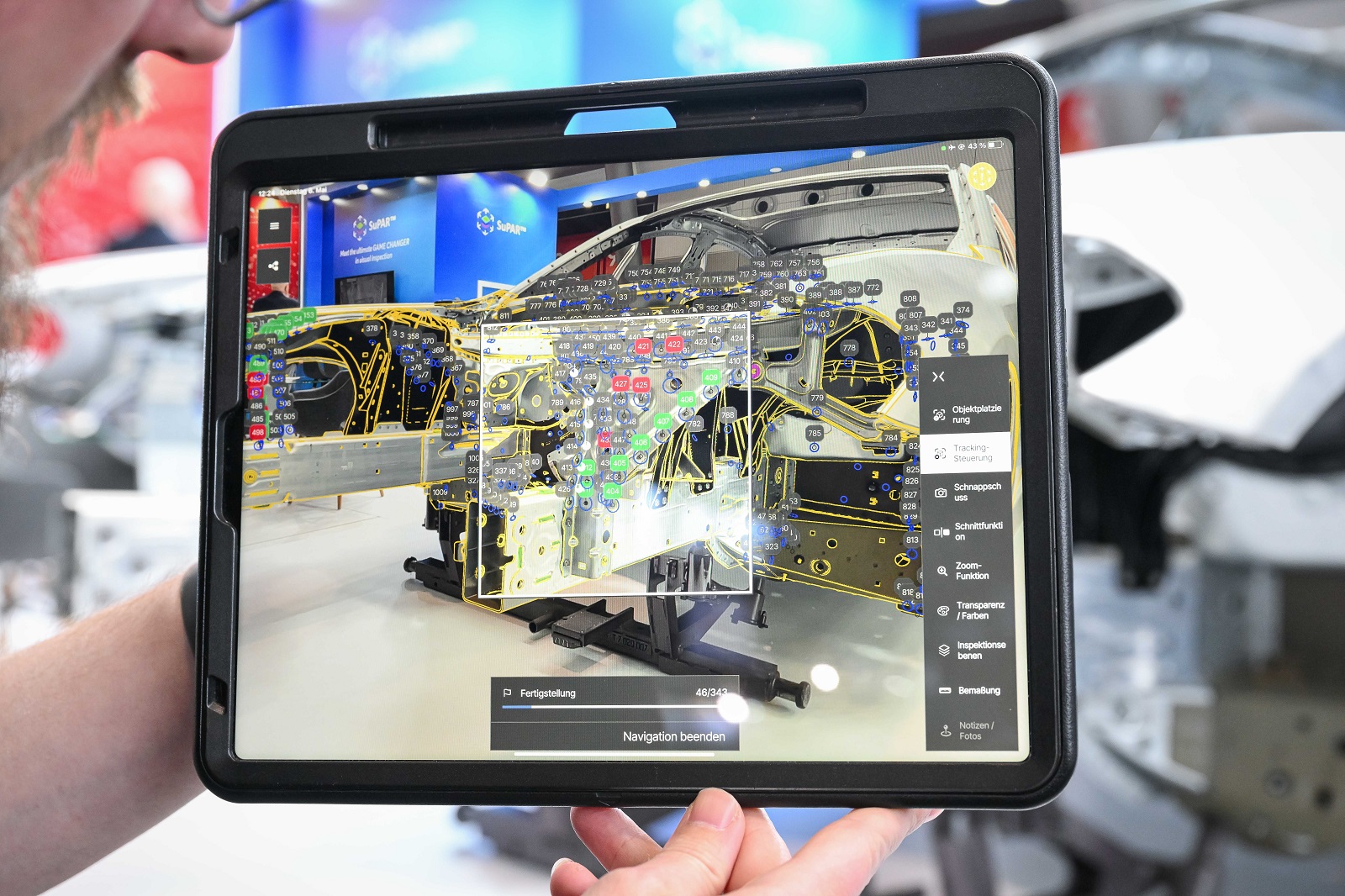
AR and AI Transform Visual Inspection with SuPAR.
As manufacturing continues its digital transformation, quality inspection processes are becoming increasingly critical in meeting demands for speed, accuracy, and traceability. With its New Release, SuPAR, an augmented reality (AR) and AI-powered visual inspection solution, introduces a new benchmark for quality control on the shop floor.
The latest SuPAR release enables real-time visualization of CAD data directly on physical parts, allowing deviations and assembly issues to be detected instantly during inspection. With enhanced tracking performance, CAD-to-real-world measurement capabilities, flexible markup tools, and AI-driven analysis, quality inspection workflows become faster, more reliable, and more standardized.
Enhanced Tracking for Accurate Visual Inspection
Tracking remains the core functionality of SuPAR, and the New Release delivers major improvements across the tracking pipeline. Enhanced edge creation in SuPAR Composer is combined with dynamic edge generation, advanced search, and filtering capabilities within the application. These updates result in smoother visualization, increased stability, and improved accuracy during inspections.
Extensive simulations and real-world tests on physical parts demonstrate measurable improvements in tracking precision, as well as a more intuitive and efficient user experience for quality teams.
CAD-to-World Measurement Capability
One of the most requested functionalities is now available. With the improved tracking engine, SuPAR enables CAD-to-World Measurement, allowing distance estimation between CAD coordinates and real-world coordinates – and vice versa. This capability provides valuable spatial awareness for inspection tasks such as assembly verification, positioning checks, and tolerance evaluation.
By bridging the gap between digital design data and physical reality, inspectors gain deeper insight into deviations directly on the shop floor.
Flexible Markups Beyond CAD-Defined Features
In real production environments, not all critical operations are fully defined in CAD data. Welding seams, sealant paths, and other manual processes often require additional inspection references. With the New Release, SuPAR introduces polyline and polygon markup creation, enabling inspectors to define and evaluate features beyond CAD geometry.
This flexibility allows quality inspection processes to better reflect real manufacturing conditions and operational requirements.
Faster Workflows with Context Menus
As SuPAR Composer continues to evolve with expanded functionality, usability and speed become essential. The New Release introduces right-click context menus that provide quick access to frequently used actions on selected tools. This enhancement significantly streamlines daily inspection workflows and reduces unnecessary navigation steps.
AI Object Detection with Distance Estimation
The New Release also enhances SuPAR’s AI capabilities. The AI Object Detection module can now estimate the distance between the expected object location and the detected object location. This added layer of analysis supports more informed decision-making in AI-assisted quality inspection scenarios.
By combining augmented reality and artificial intelligence, SuPAR New Release delivers a smarter, faster, and more reliable approach to quality inspection. It empowers manufacturers across automotive, heavy industry, defense, and industrial equipment sectors to reduce human error, improve traceability, and increase overall production efficiency.
For more information: www.supar.eu

Restauro conservativo e digitalizzazione 3D: tecnologia e tradizione a confronto in un intervento sinergico
EdiliziAcrobatica S.p.A. Head Quarter
Nel campo della conservazione e del restauro, l'integrazione tra tecnologia digitale e metodi tradizionali sta rivoluzionando il modo in cui le opere d'arte vengono recuperate e preservate. In questo articolo analizziamo il caso di una scultura danneggiata, il cui restauro ha coinvolto tecniche di digitalizzazione 3D, modellazione avanzata e prototipazione per la ricostruzione di parti mancanti.
La scansione 3D è ad oggi la tecnologia più veloce per la ricostruzione tridimensionale, ed è lo strumento a cui hanno pensato i restauratori direzionali Stefano Baggiani e Giada Vescovo di Acrobatica Group, azienda leader nel settore della ristrutturazione e dei lavori di restauro su corda, in collaborazione con Measure 3D S.r.l., azienda di Roma con una esperienza ventennale nel servizio di acquisizione tridimensionale senza contatto e nella trasformazione dei dati in soluzioni digitali su misura, a supporto di progettazione, reverse engineering e controllo qualità.
L’Hotel Palace è una struttura alberghiera di lusso sorta nel 1906 sul terreno in cui sorgeva il Castello Maur, risalente al 1676. Dal 2005, grazie alla Proprietà, l’Hotel è oggetto di continui interventi di ristrutturazione e manutenzione. Da qui parte il progetto di restauro, che prende in carico i 12 putti decorativi del cornicione.
Le 12 statue sono posizionate lungo il cornicione delle terrazze panoramiche dell’hotel, 6 putti nella parte anteriore dell’edificio e 6 putti nella parte posteriore.

(Antica cartolina con facciata di ingresso dell’Hotel Palace)

(Hotel Palace OGGI)
L’oggetto dell’intervento è un manufatto in malta, collocato sulla parte frontale dell’edificio.
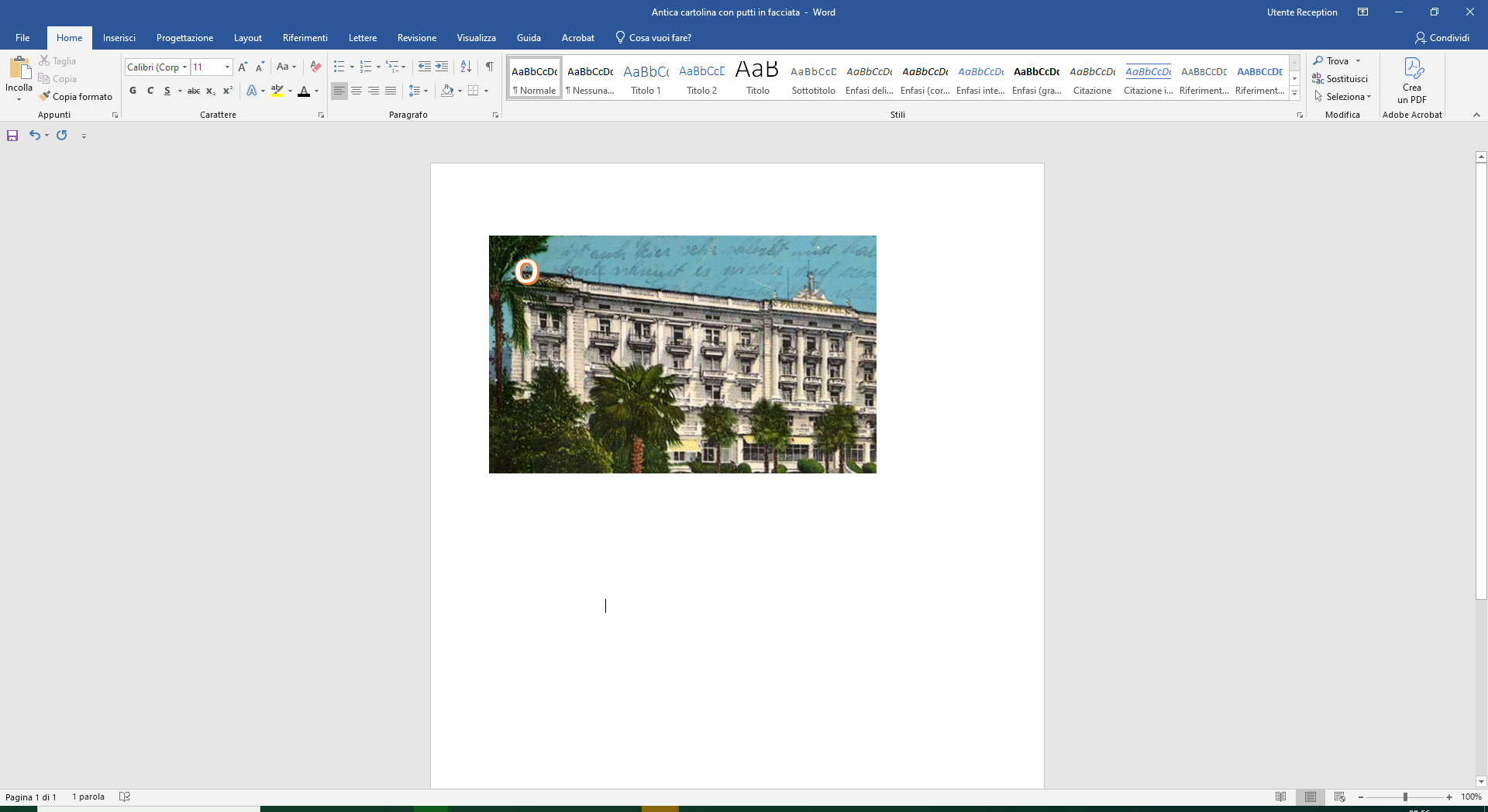
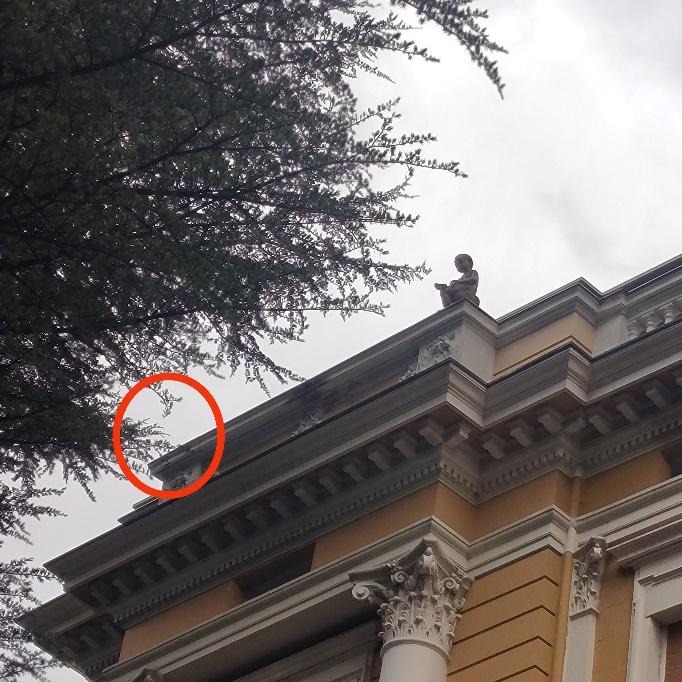
La statua era compromessa da danni strutturali che ne avevano causato la perdita di alcune porzioni.
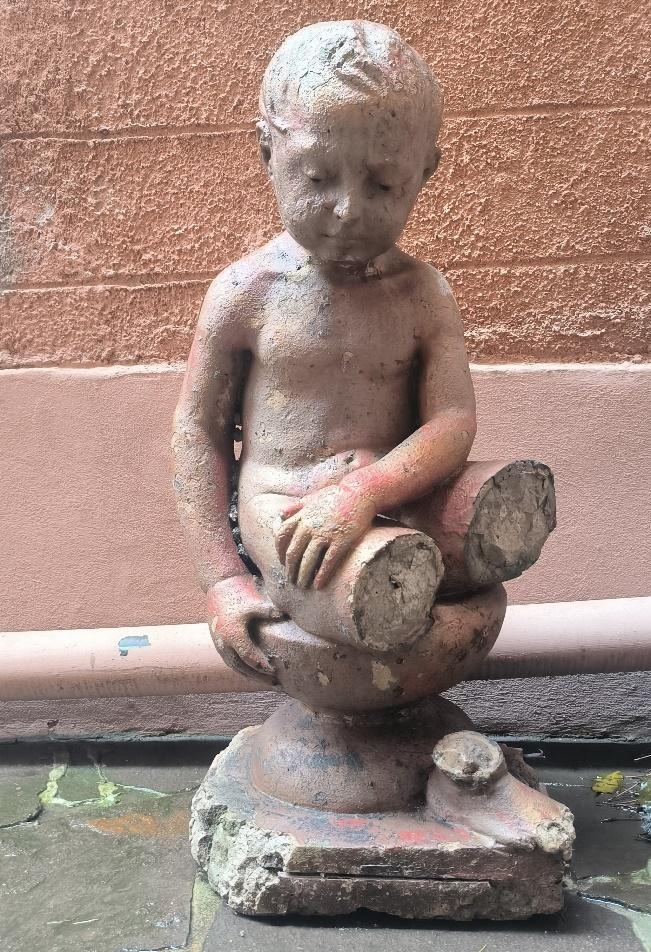
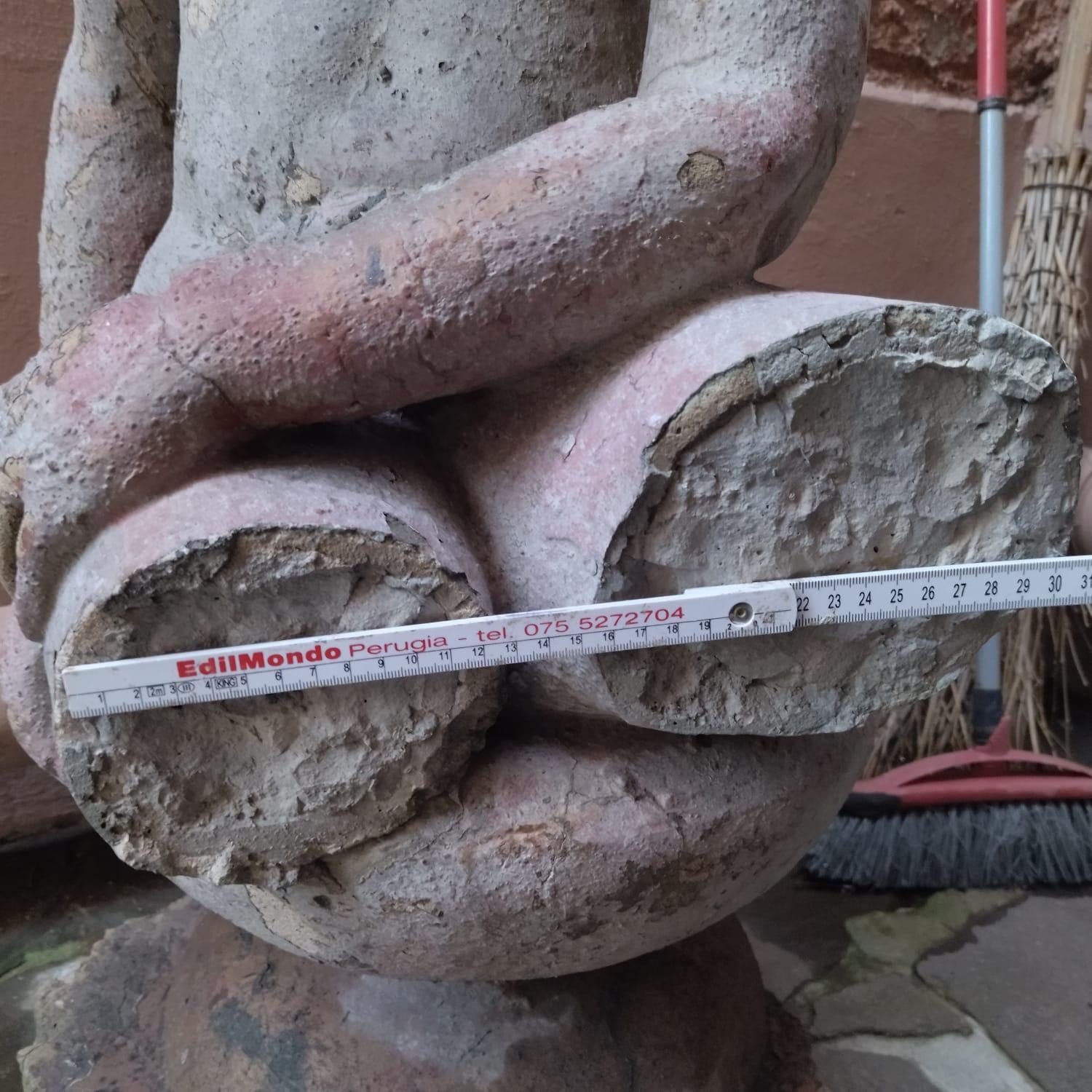
(Scultura danneggiata prima del restauro)
L’esposizione prolungata agli agenti atmosferici ha causato un progressivo e disomogeneo deterioramento della materia di cui consta la scultura, con conseguente perdita di alcuni suoi elementi strutturali, in particolare le gambe. L'opera si trovava in uno stato critico e necessitava di un intervento di restauro che preservasse la sua integrità senza alterarne l’autenticità storica ed estetica.
Grazie all'impiego di sistemi di scansione 3D senza contatto a luce strutturata, modellazione digitale e stampa 3D, è stato possibile ricostruire fedelmente gli elementi mancanti, garantendo un ripristino rispettoso dell'opera originale.
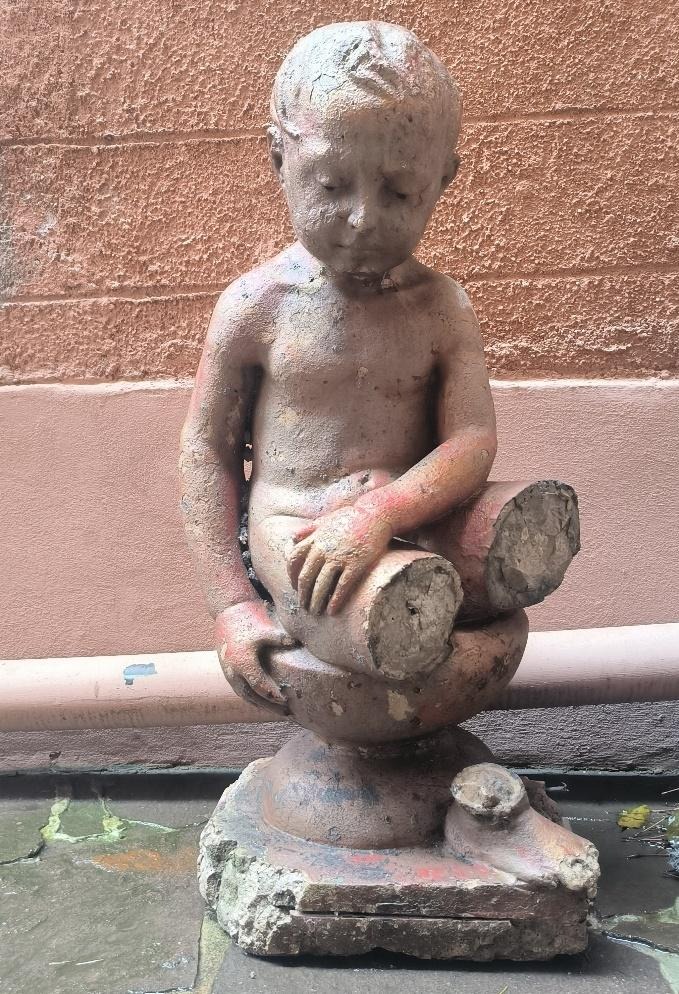
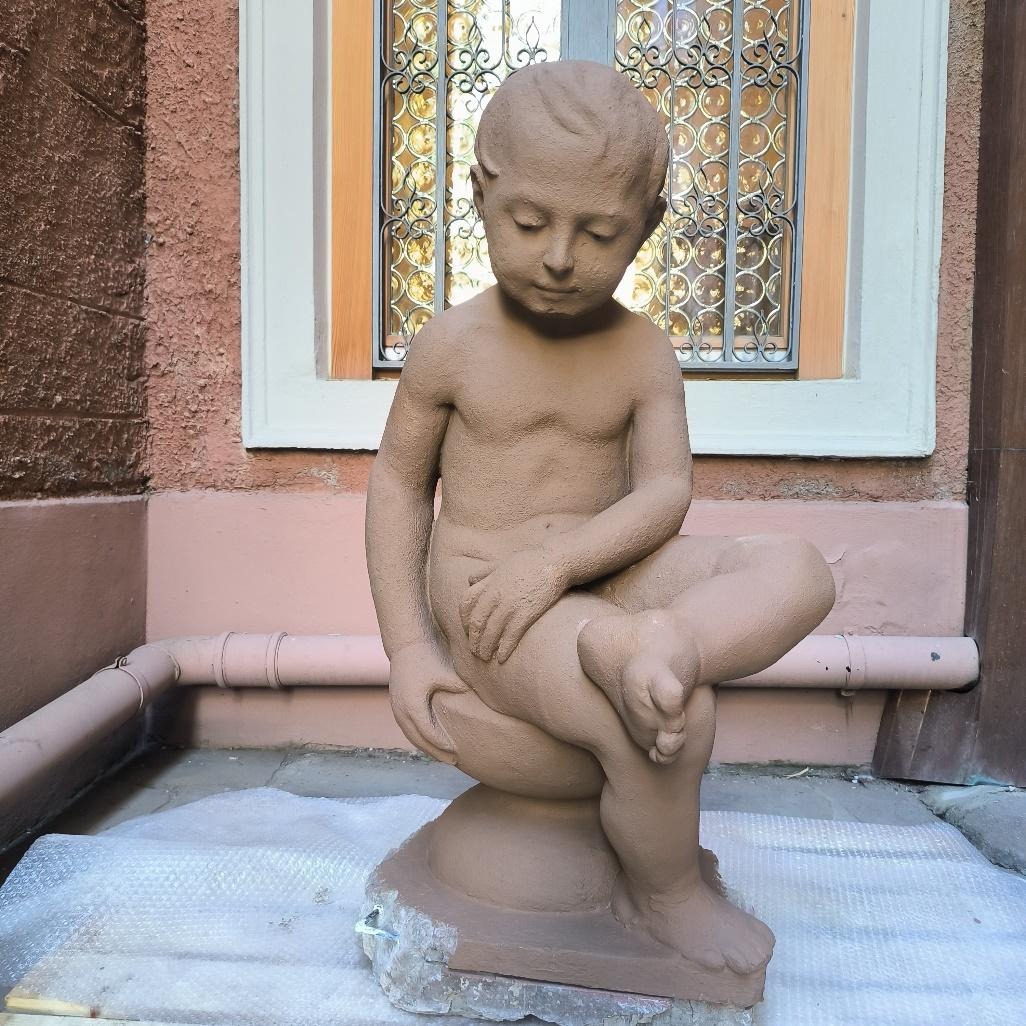
Fasi del Processo
1. Digitalizzazione 3D
La prima fase del lavoro ha previsto la scansione tridimensionale della scultura mutilata
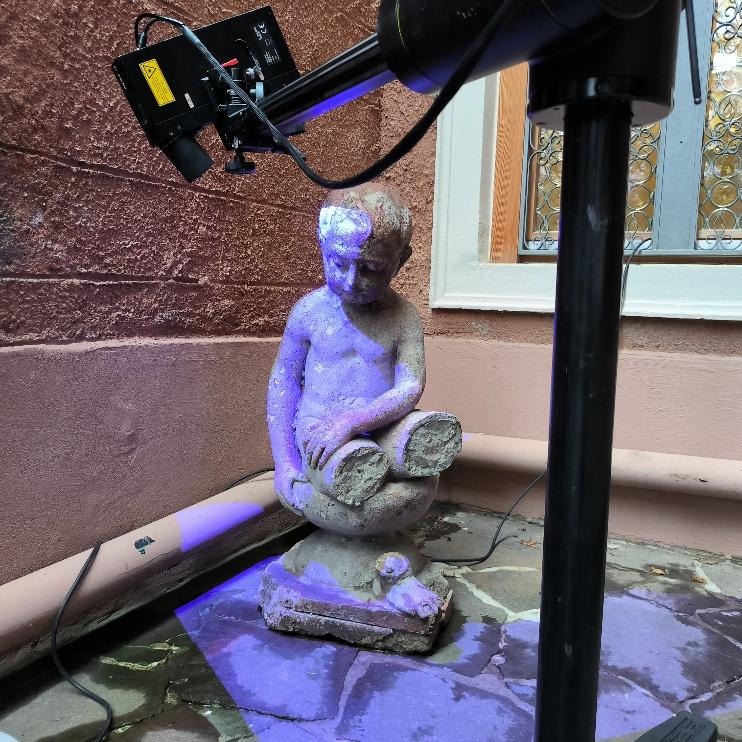
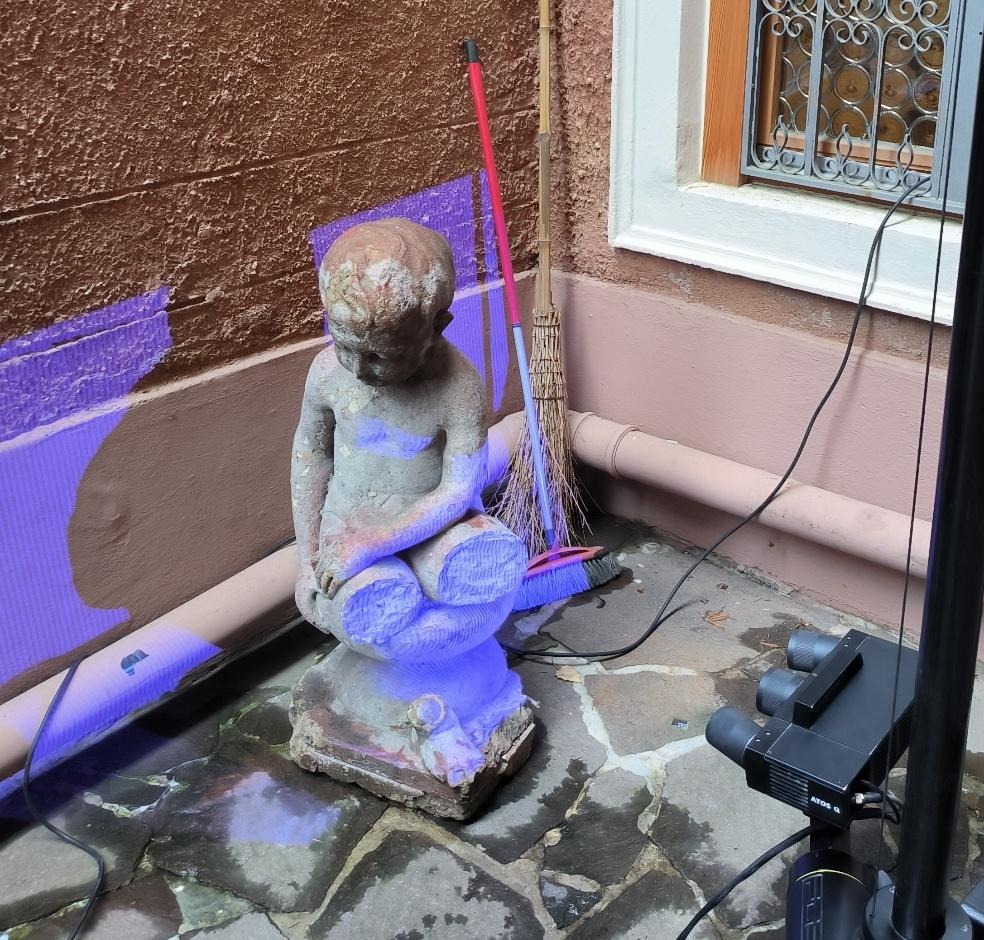
(Scultura danneggiata con proiezione di luce da scansione 3D)
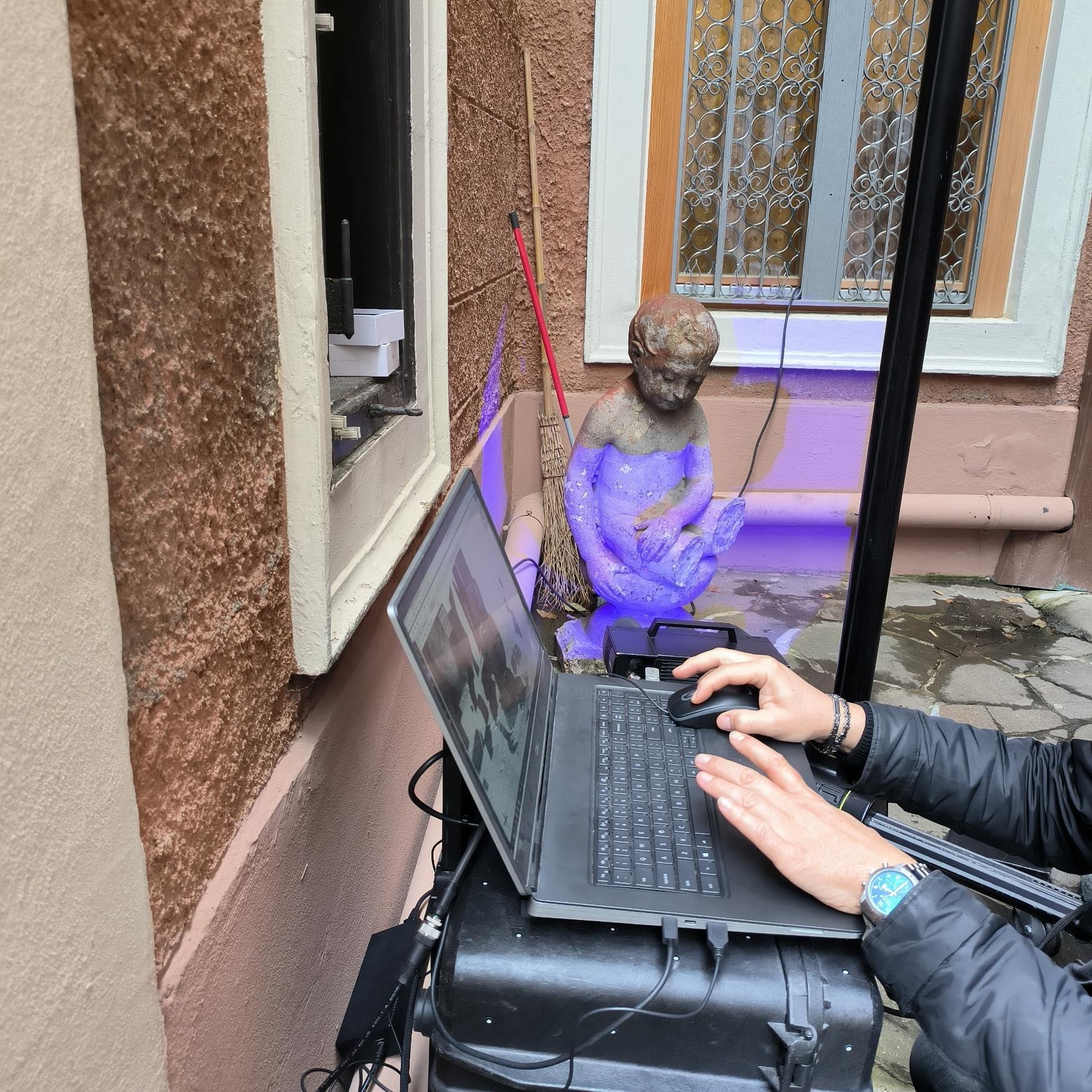
(Andrea Rosichini, di Measure 3D al lavoro sulla scansione della scultura. Scanner in azione sulla superficie della statua)
E di una gemella integra per ottenere riferimenti precisi.
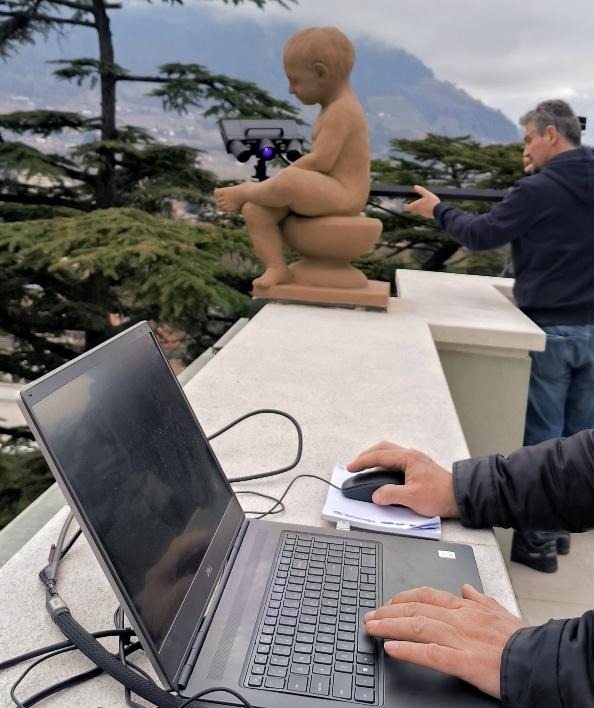
(Danilo Salzano e Andrea Rosichini di Measure 3D S.r.l. a lavoro sulla scansione della scultura integra master)
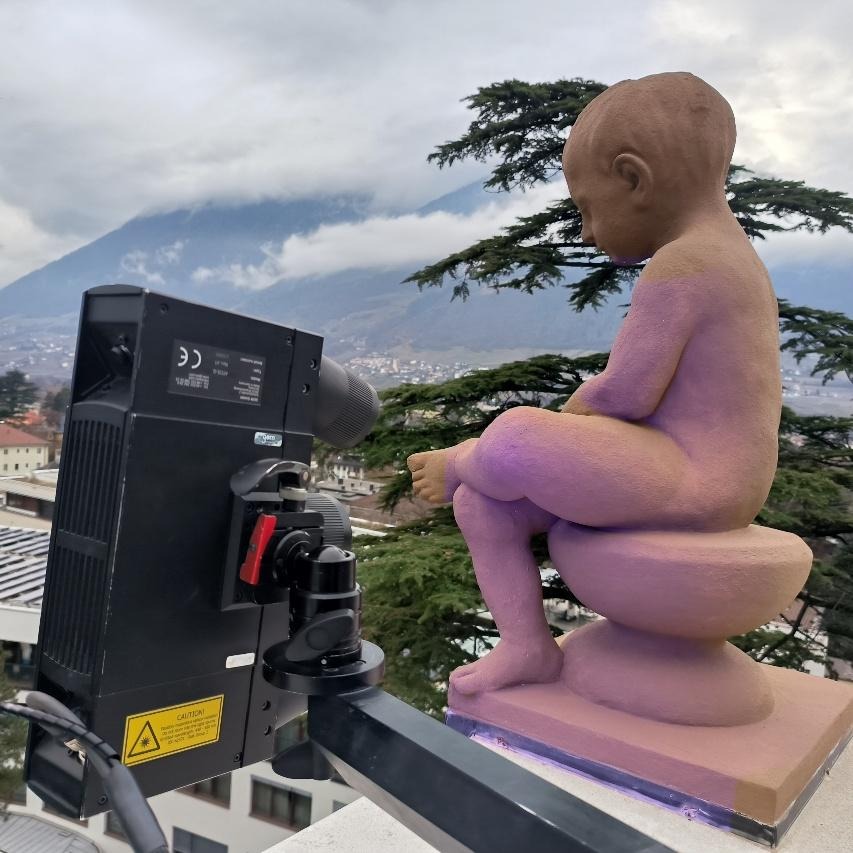
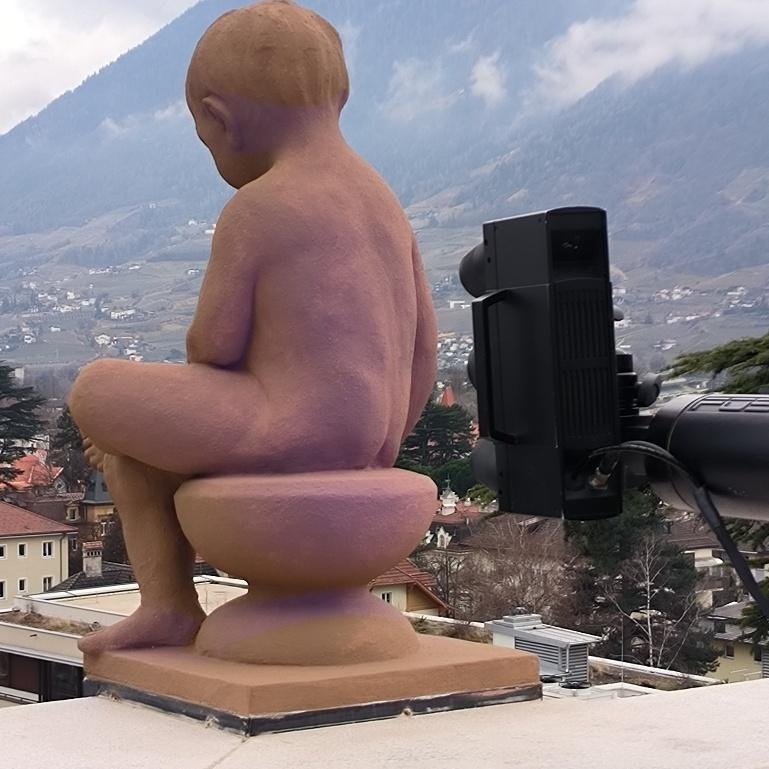
(Scansione della scultura integra)
Con strumenti avanzati come il sistema di scansione ottico ZEISS ATOS Q è stato possibile ottenere una mesh dettagliata, da cui è stato elaborato un modello digitale preciso.
2. Editing e Modellazione 3D
Una volta acquisiti i dati della scultura, la porzione mancante è stata ricostruita digitalmente con software di modellazione 3D.
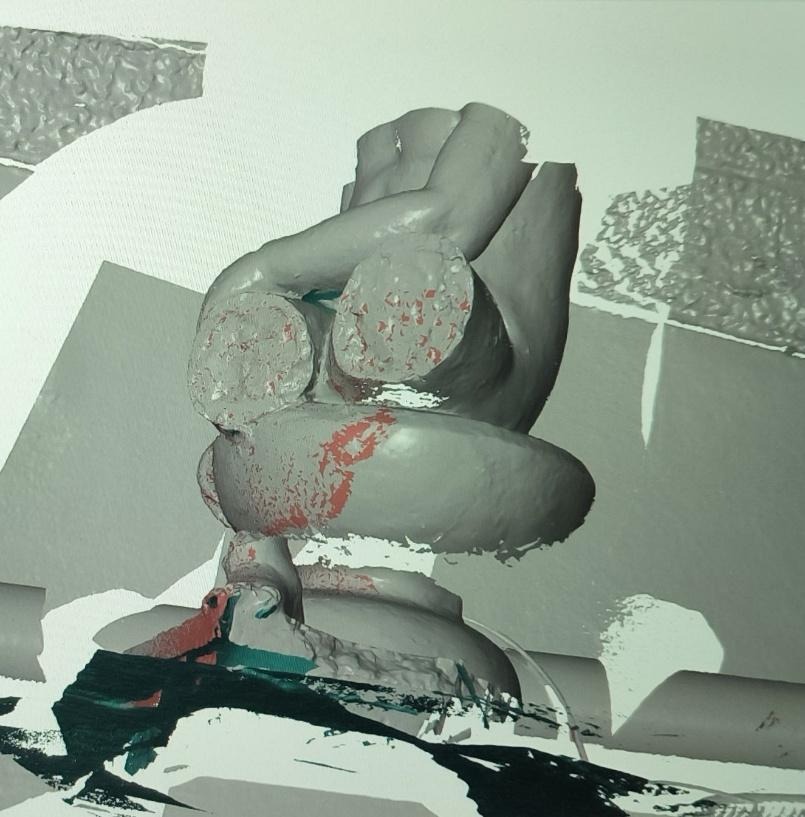
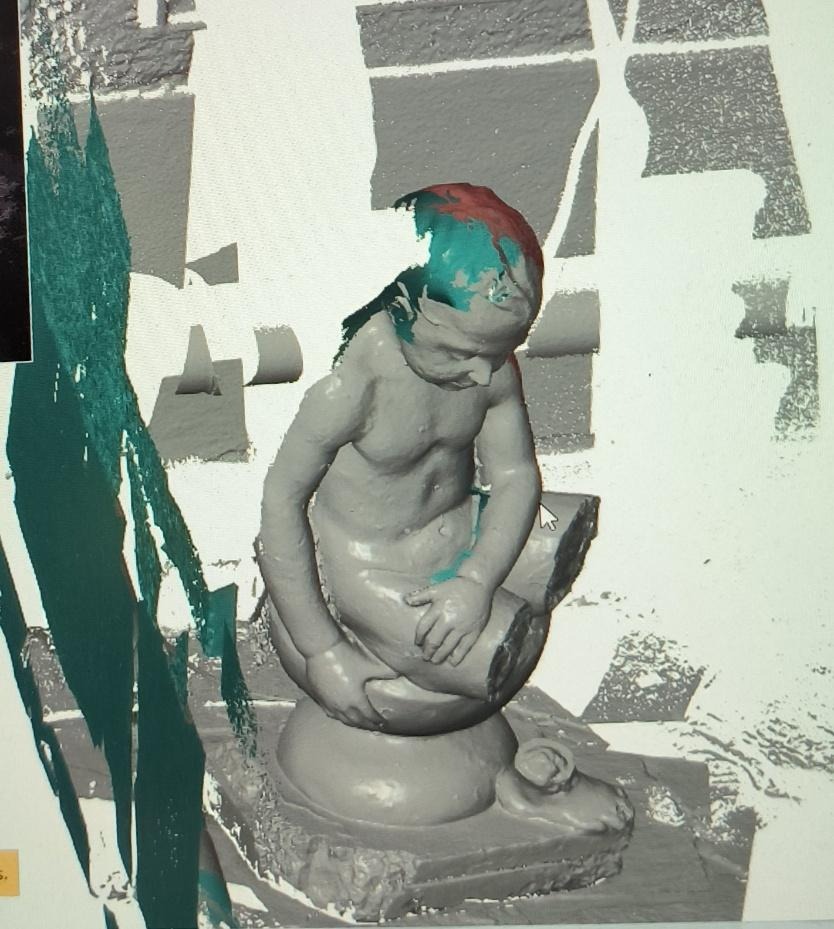
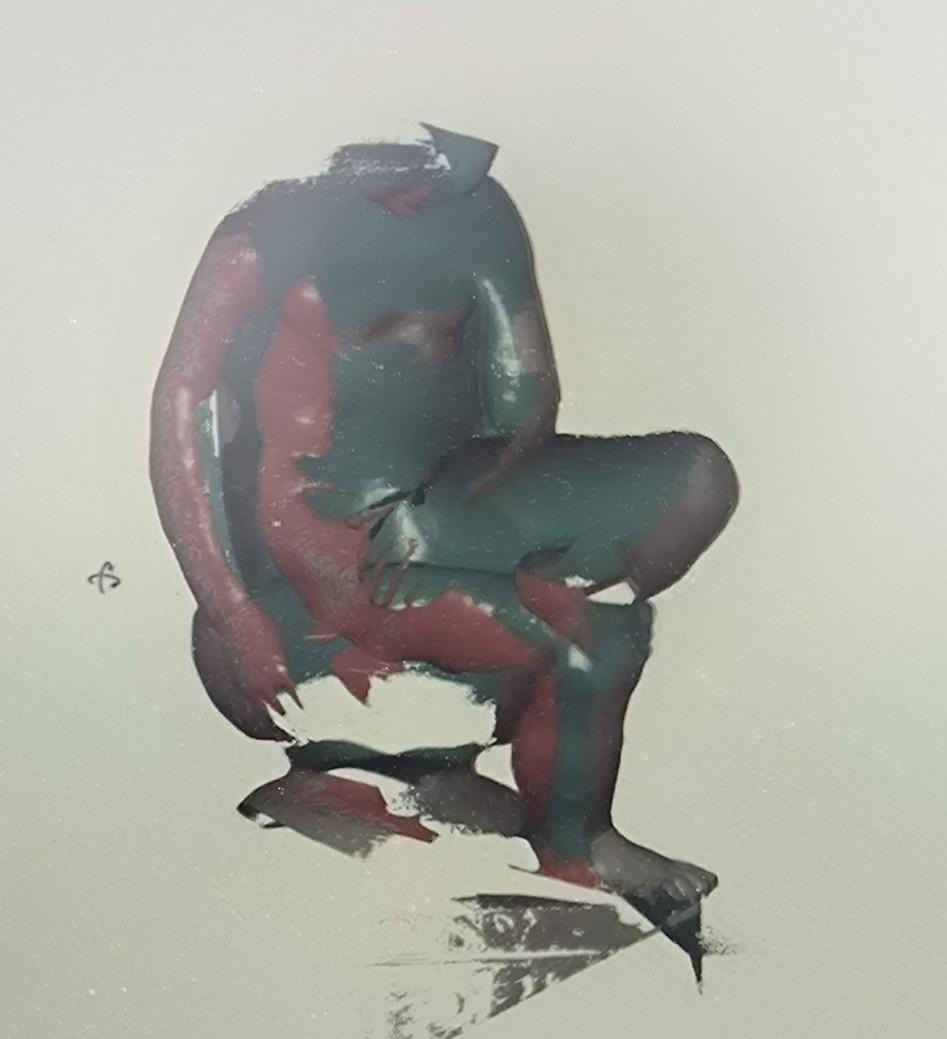
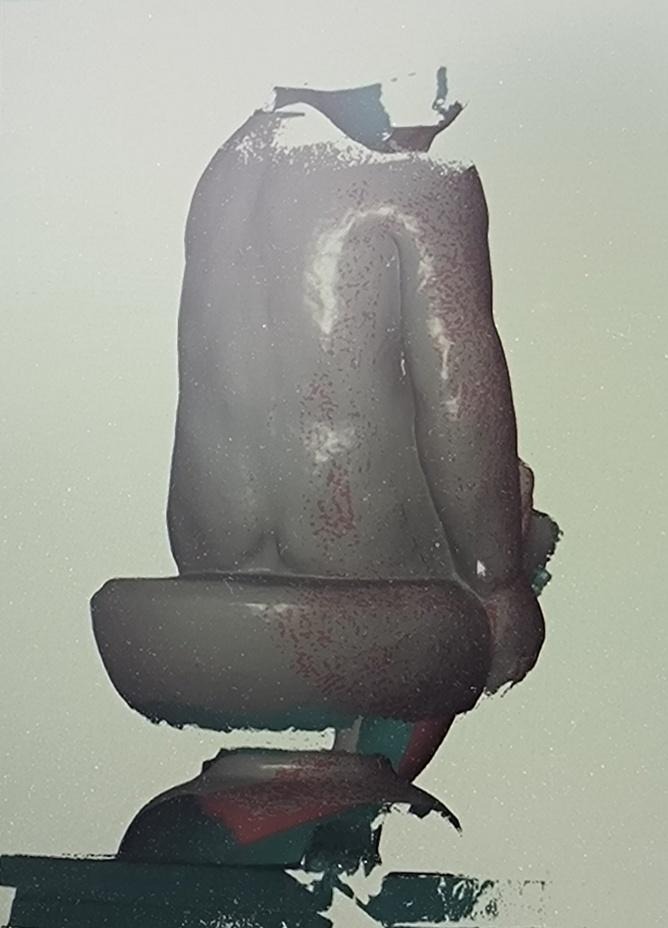
(Preview digitale della scansione della scultura con parti mancanti evidenziate)
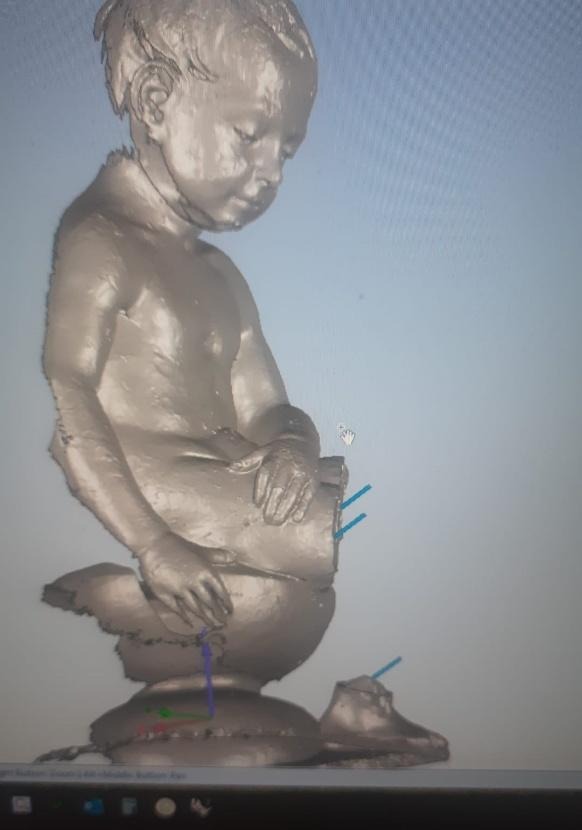
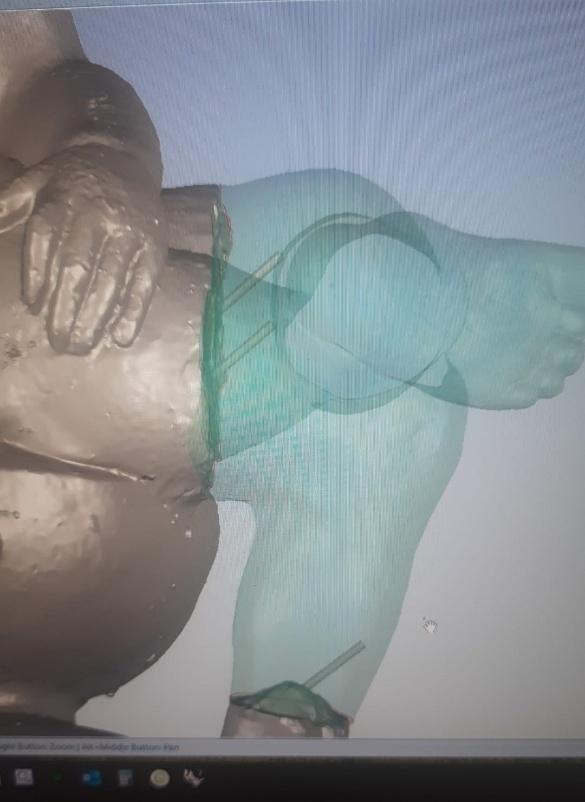
(Ricostruzione digitale in 3D delle gambe con riferimenti di ancoraggio)
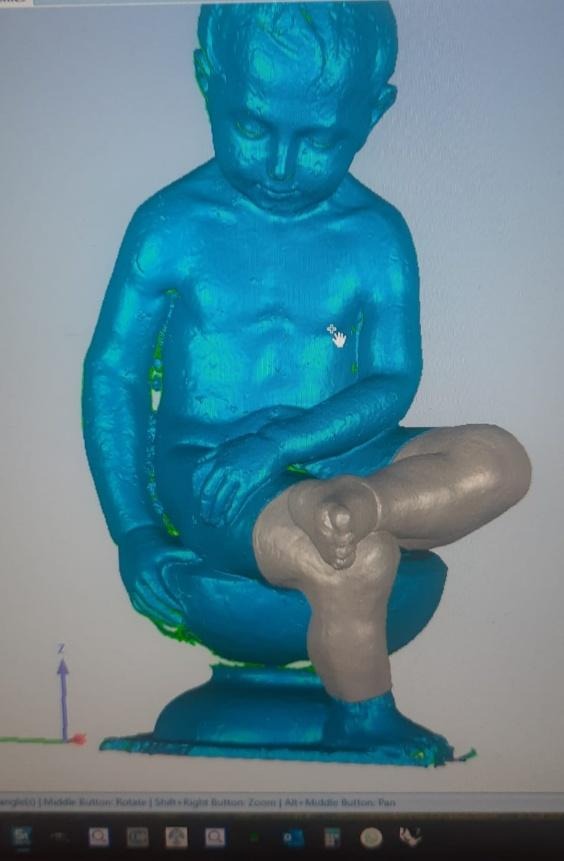
(Modello 3D combinato della scultura con parti nuove e originali)
Questo passaggio di comparazione tra le due scansioni, quella della statua integra e quella mutilata, è stato cruciale per assicurare la coerenza stilistica e dimensionale della parte restaurata rispetto all'originale.
3. Prototipazione e stampa 3D
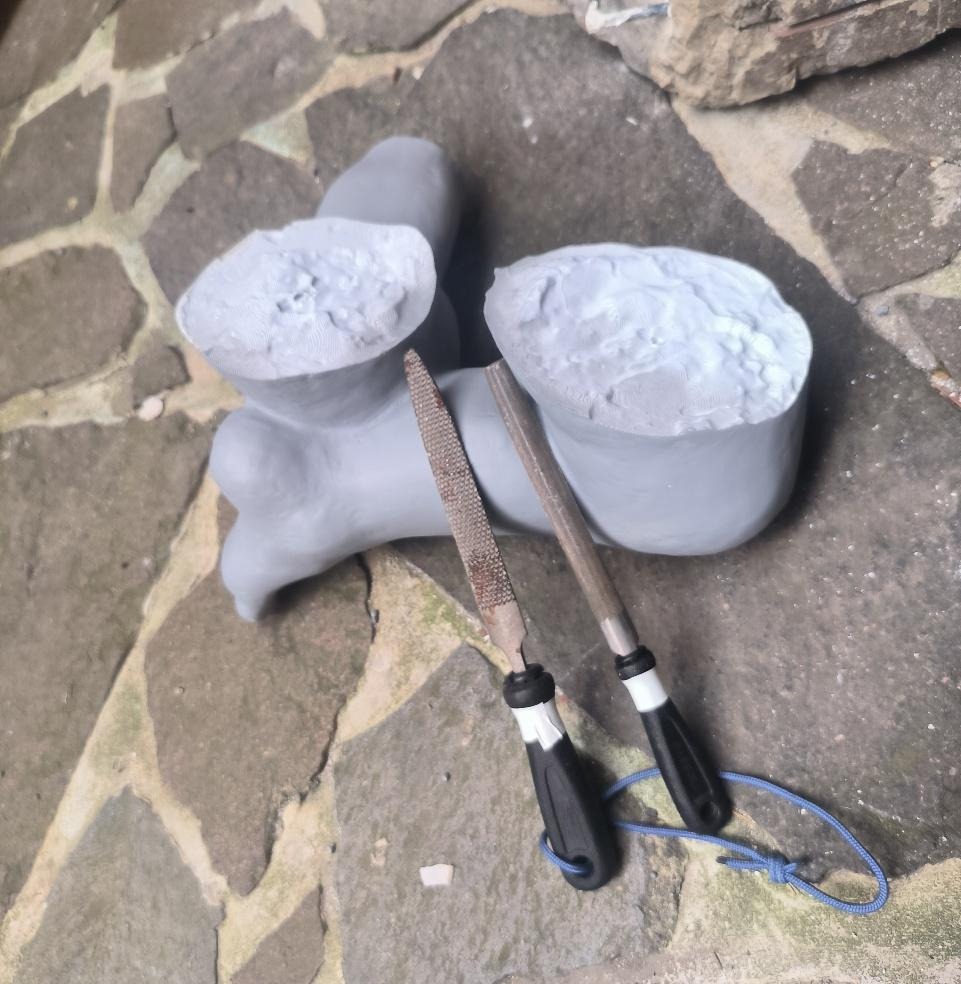
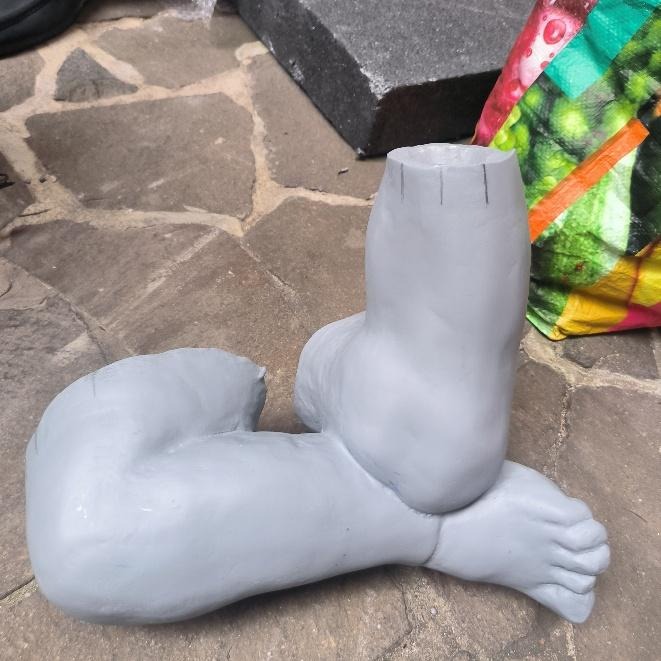
Grazie alla collaborazione dell’azienda M3D di Andrea Mastracci di Roma, specializzata in stampa 3D, è stato possibile ricostruire la parte mancante che è stata realizzata utilizzando materiale PET, opportunamente stuccato e rifinito per ottenere una texture compatibile con la superficie originale.
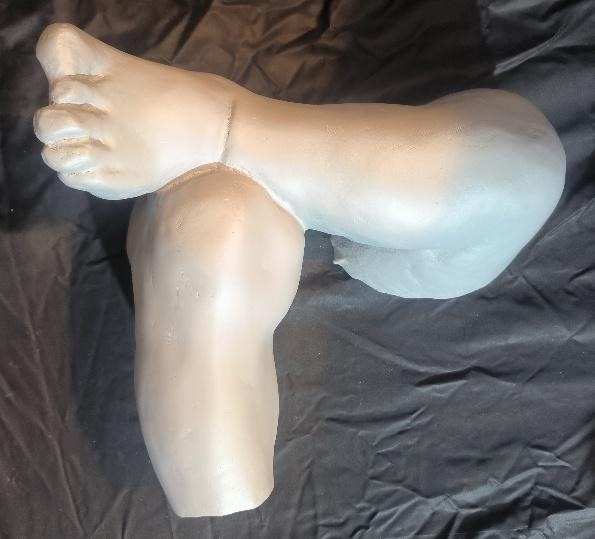
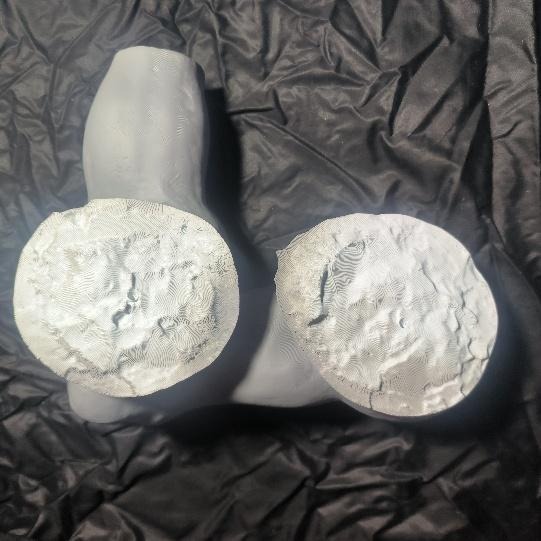
(Modello stampato in 3D delle nuove gambe, vista frontale) (Dettaglio della base delle gambe stampate con texture)
Il processo di levigatura ha migliorato la resa estetica, eliminando piccole imperfezioni della stampa 3D.
4. Consolidamento e Stuccatura
Prima delle stuccature, è stato applicato un fissativo sull'intera superficie della statua, propedeutica per la fase successiva del restauro.
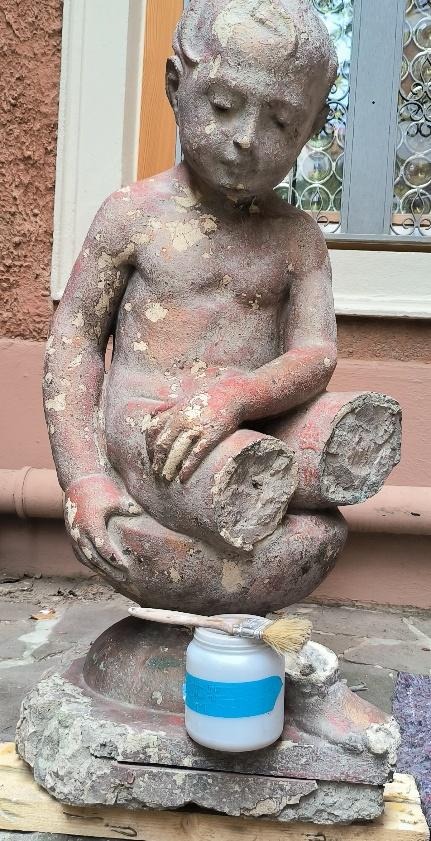
(Applicazione del fissativo sulla scultura)
Successivamente, la scultura è stata sottoposta a un intervento di stuccatura e consolidamento per preparare la superficie al restauro.
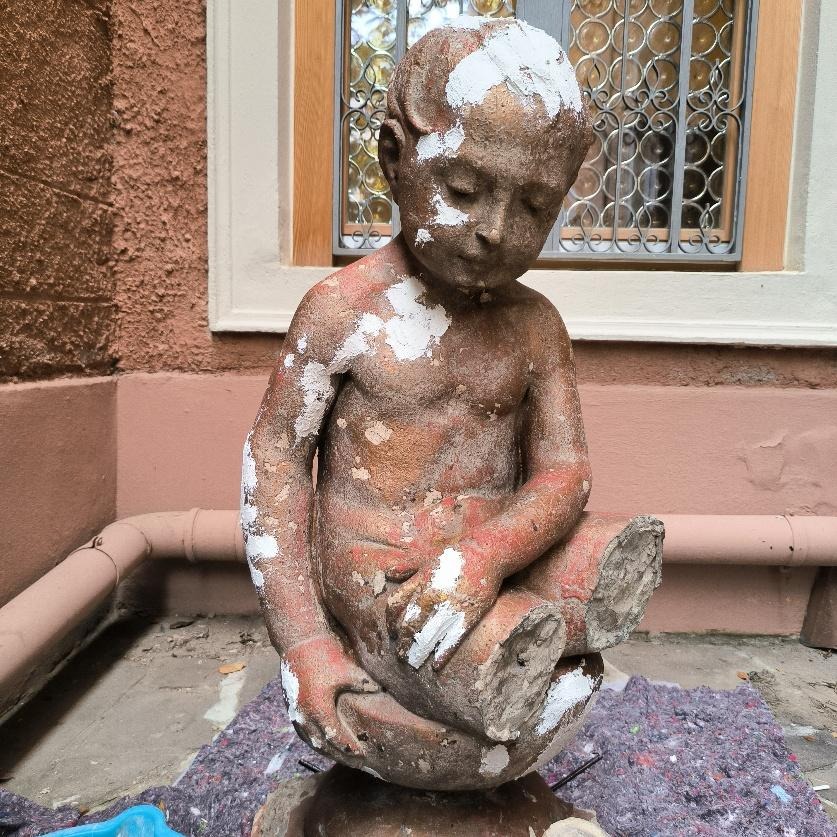
(Dettaglio della stuccatura sulle parti danneggiate)
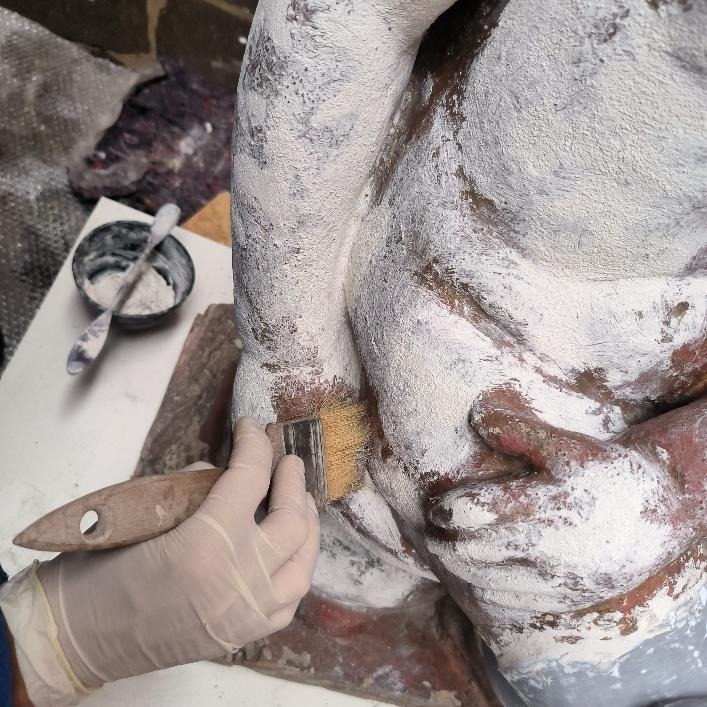
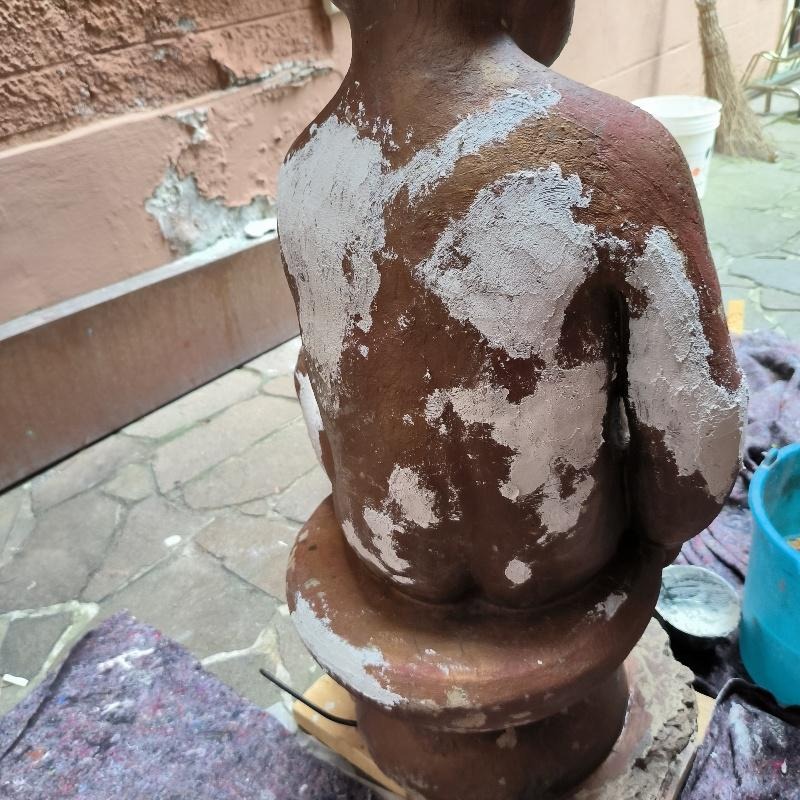
(Applicazione manuale dello stucco) (Retro della scultura)
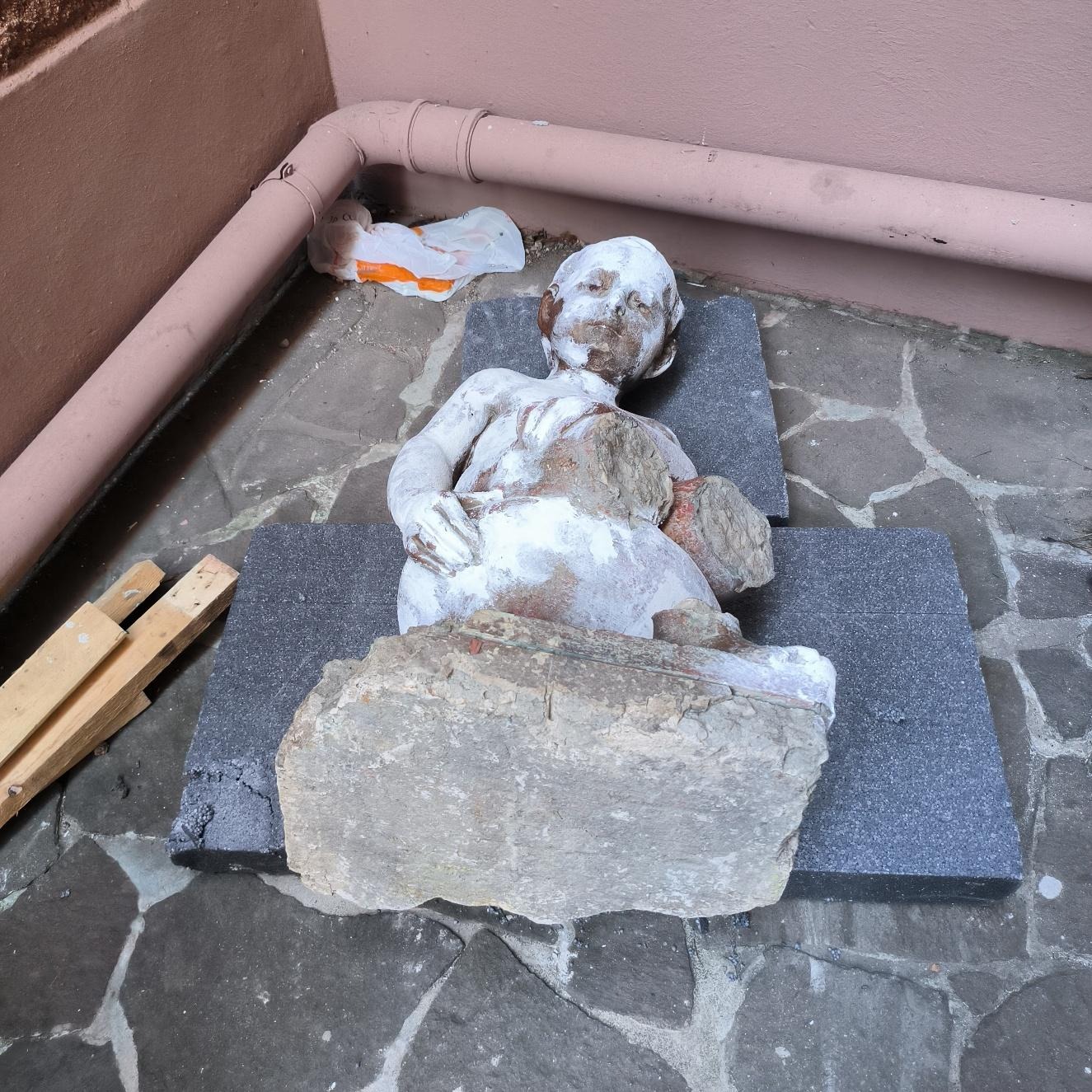
(Scultura sdraiata per facilitare la ripresa fotografica di tutte le stuccature)
5. Assemblaggio con perni e fissaggio con adesivi
Dopo un accurato test di montaggio, la parte stampata in 3D è stata assemblata alla scultura originale utilizzando perni in vetroresina per garantire stabilità strutturale. Successivamente, il fissaggio è stato completato con l’applicazione di resine epossidiche bicomponenti, per assicurare un'integrazione solida e duratura.
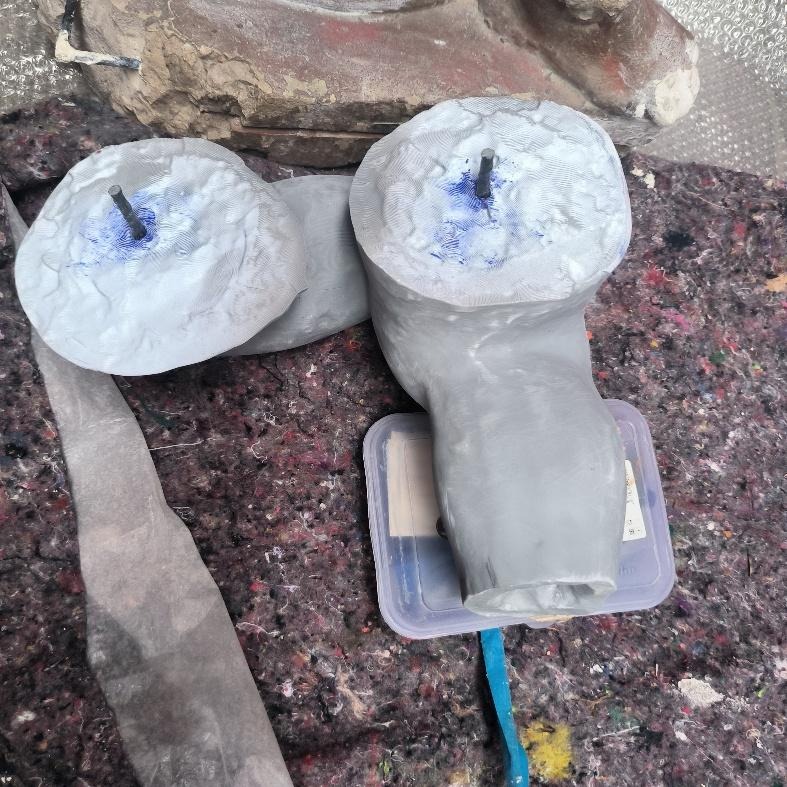
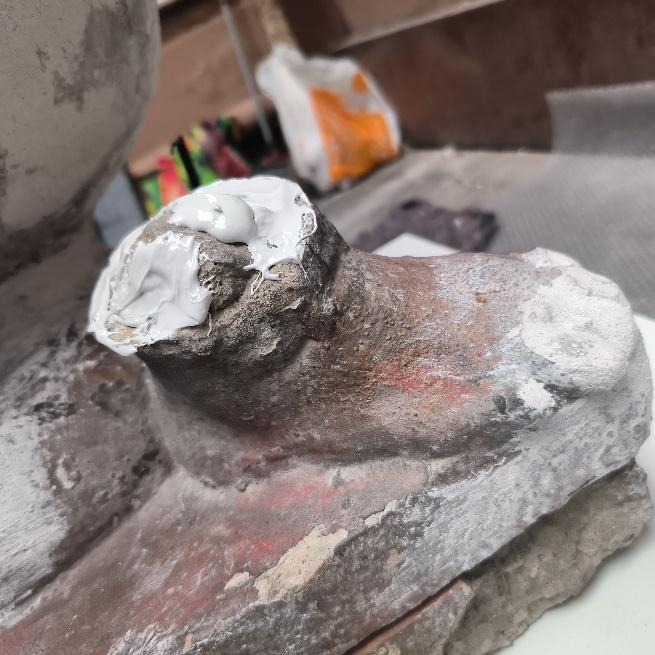
(Perni inseriti nelle nuove gambe per l’assemblaggio e resina per incollaggio)
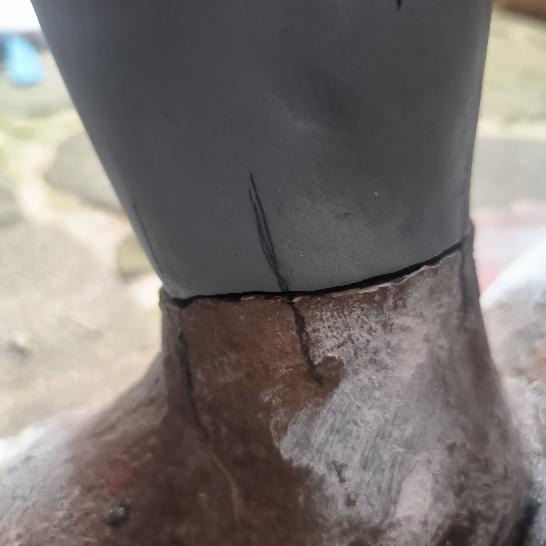
(Dettaglio delle gambe stampate in 3D con segni di ancoraggio per il montaggio)
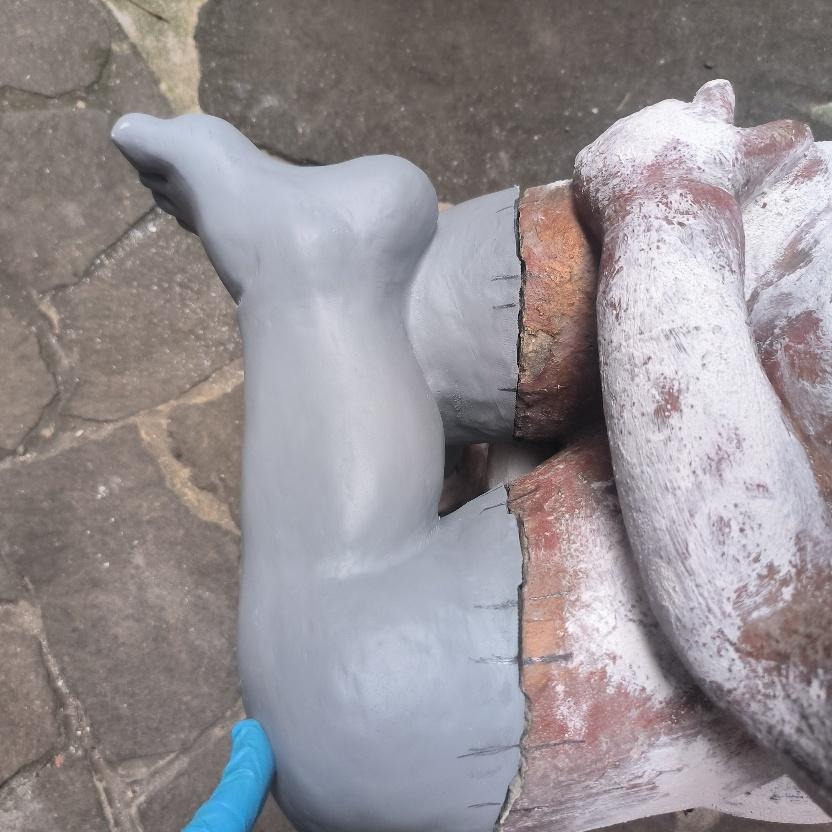
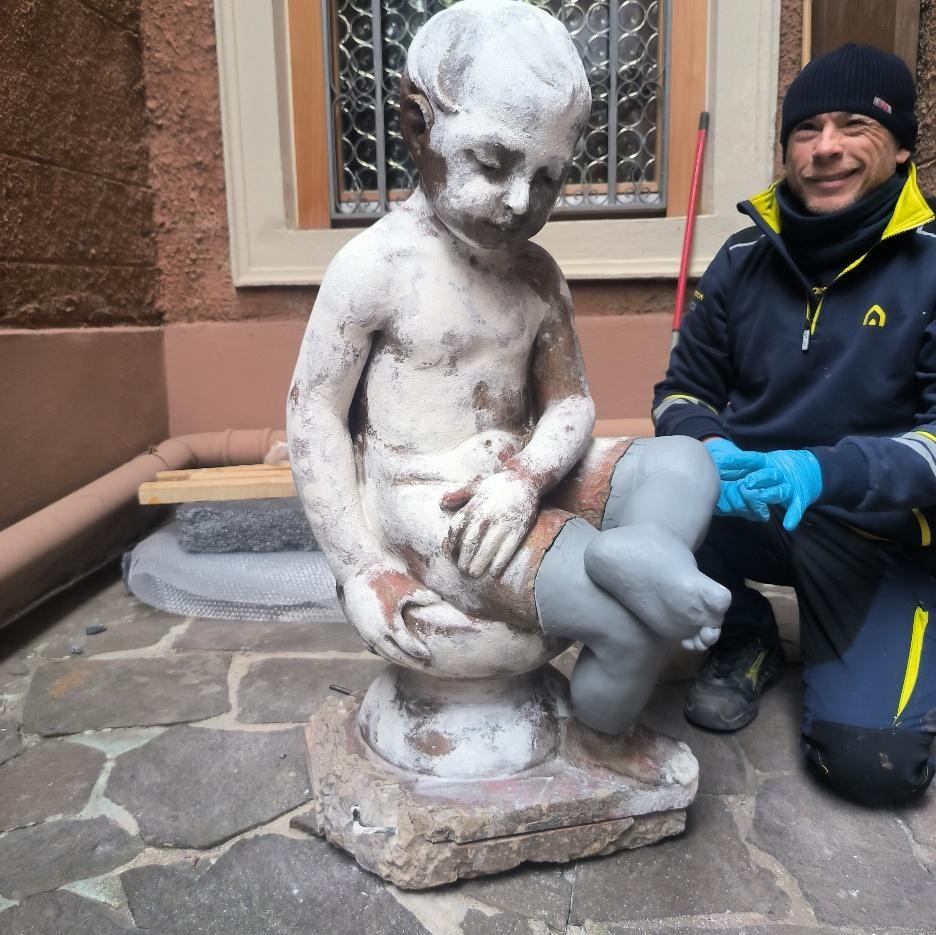
(Dettaglio delle gambe stampate in 3D con segni di ancoraggio per il montaggio)
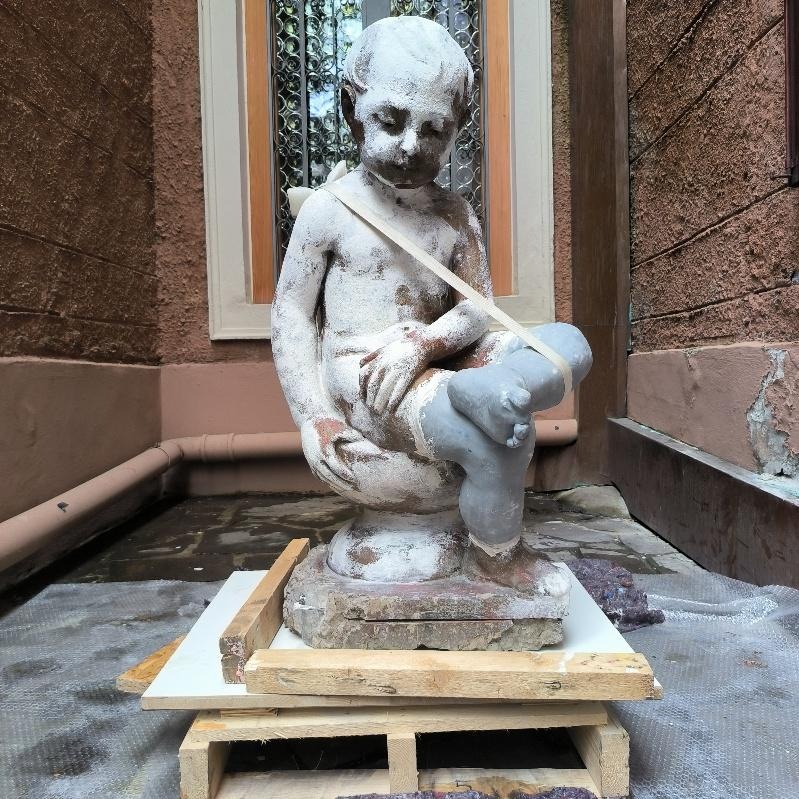
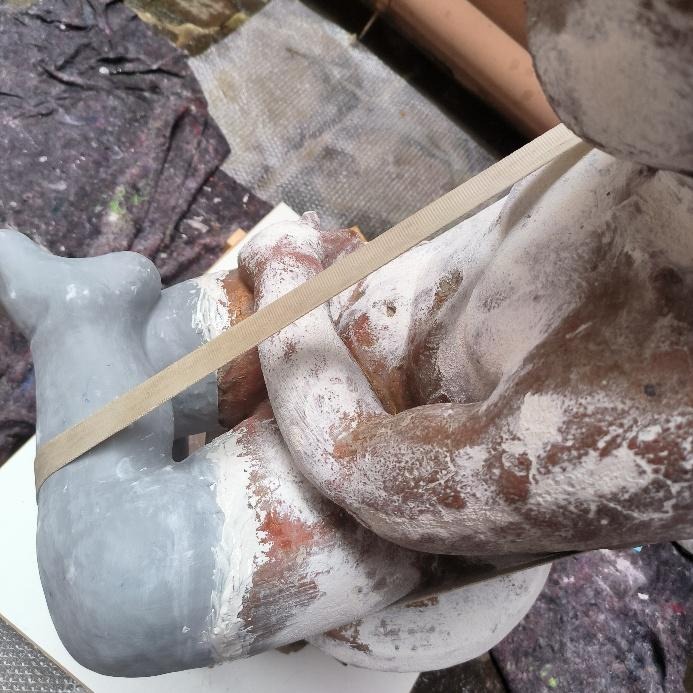
(Sistema di trazione per il fissaggio delle nuove parti)
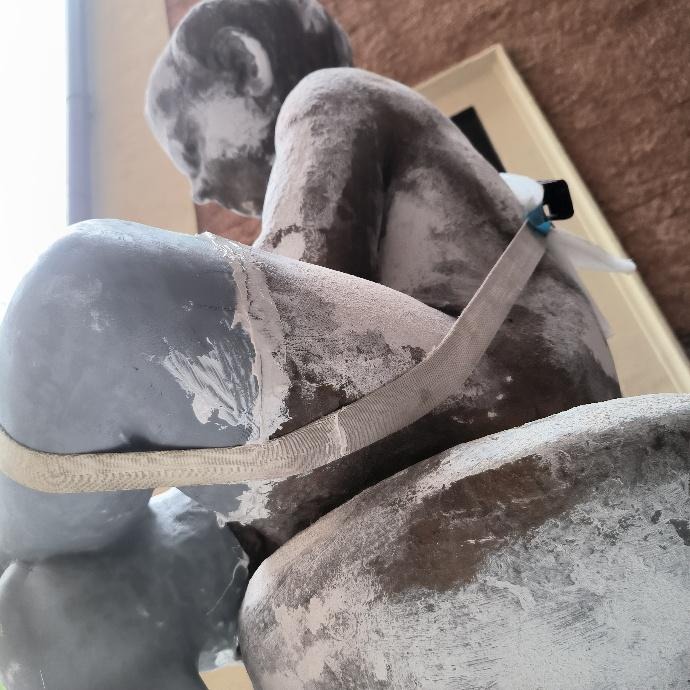
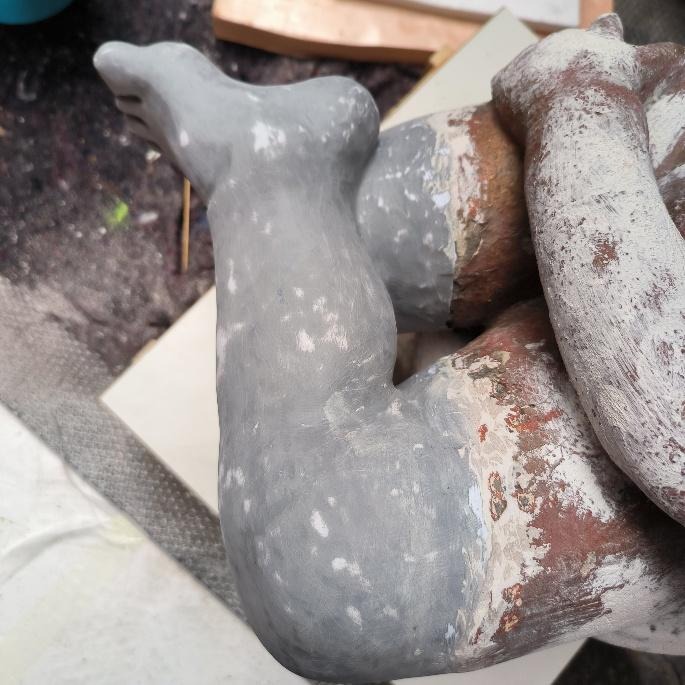
(Visione laterale del sistema di tensione per l’assemblaggio definitivo)
(Dettaglio dell’unione tra parte originale e ricostruzione 3D)
6. Finitura cromatica e protezione
L’ultimo passaggio ha riguardato l’omogeneità visiva tra l’elemento aggiunto e la scultura, mediante trattamenti superficiali per riprodurre la patina dell’opera originale. Sono stati inoltre applicati prodotti protettivi idrorepellenti per garantire la durabilità del restauro nel tempo.
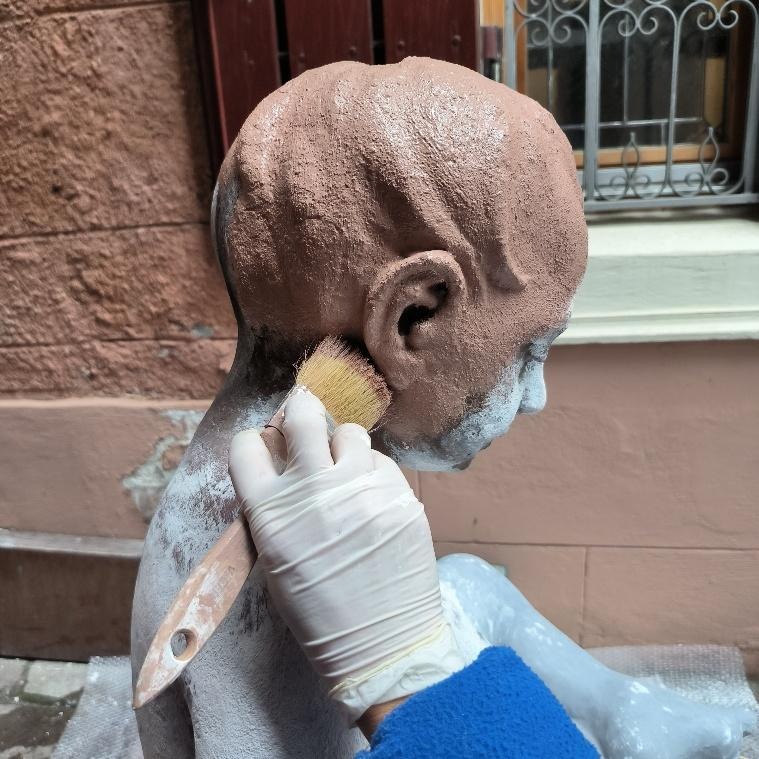
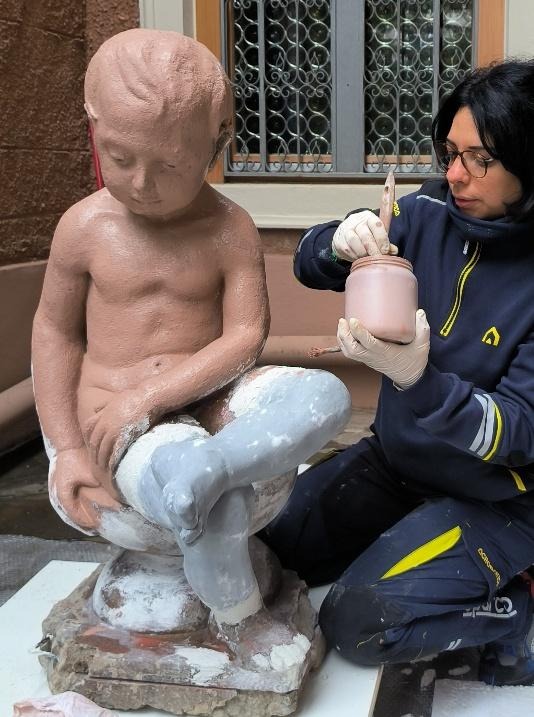
(Applicazione di coloritura)
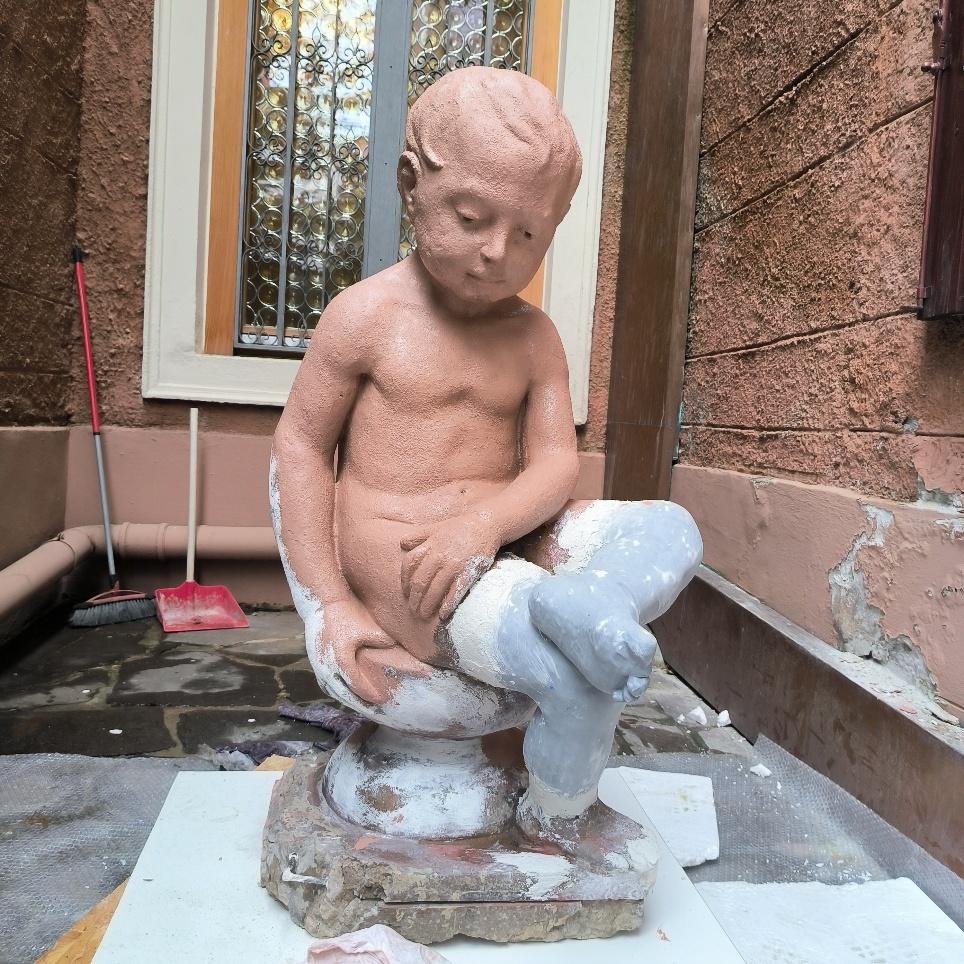
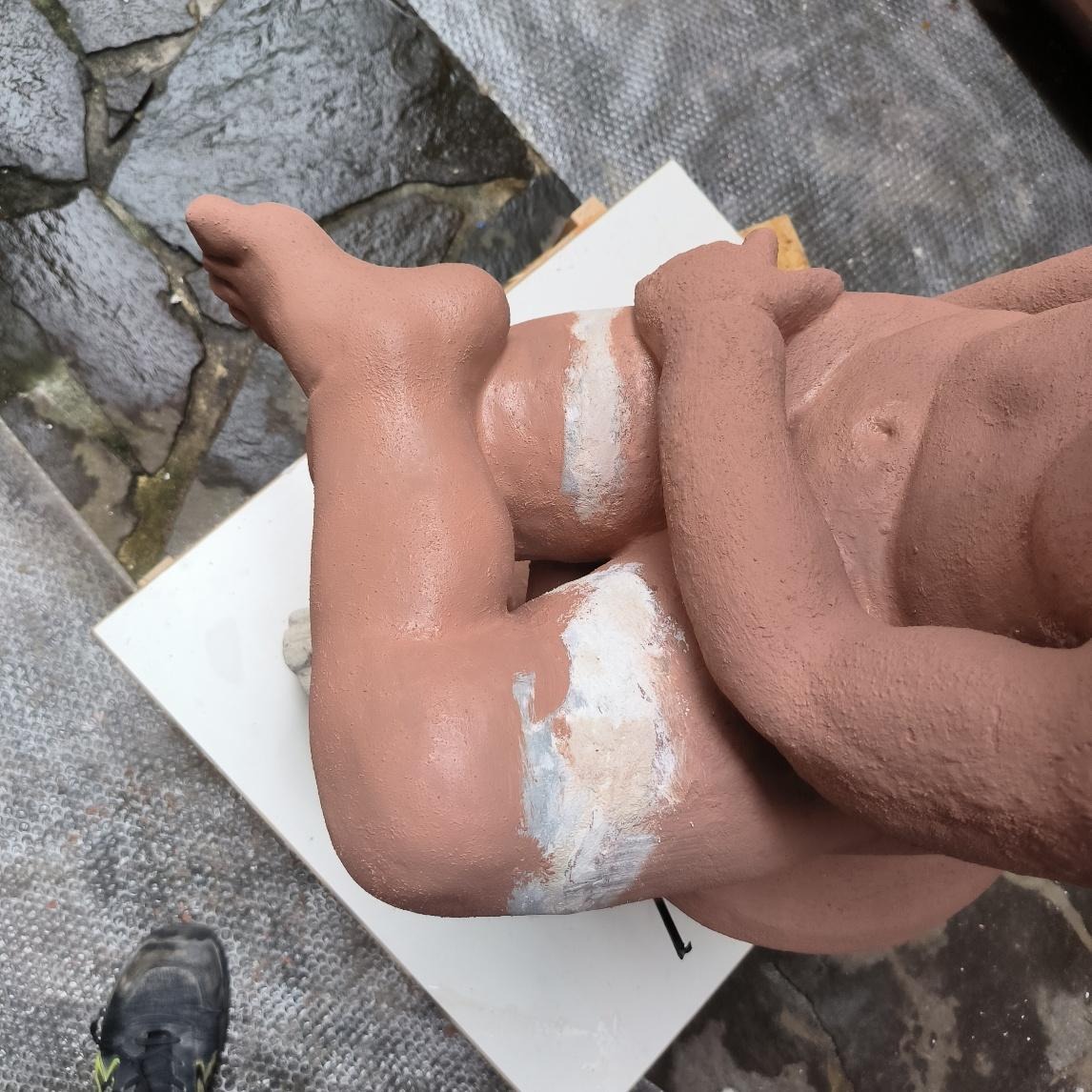
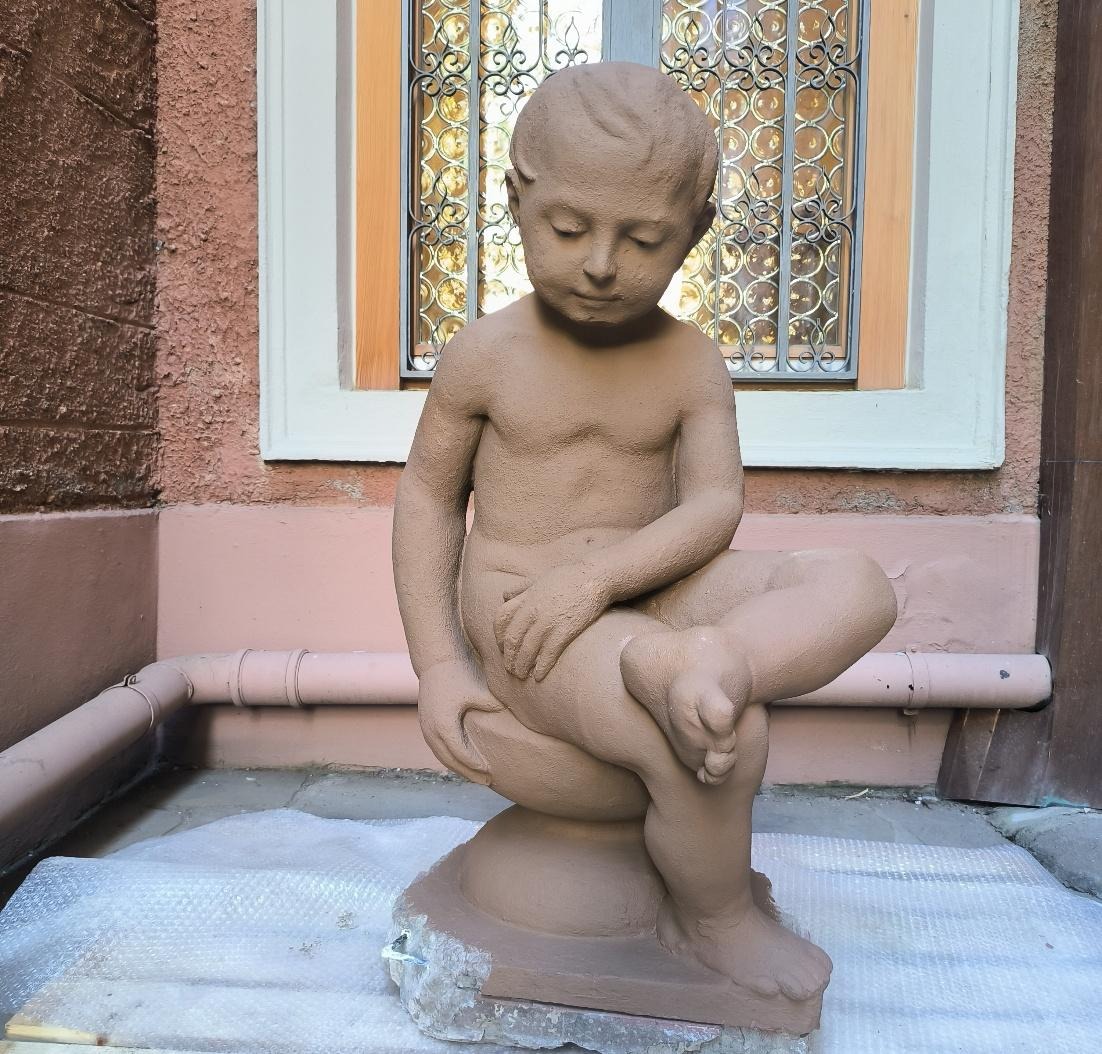
(Visione della scultura restaurata con finitura completa)
Conclusione
Il restauro di questa scultura rappresenta un perfetto esempio di sinergia tra innovazione e tradizione. La digitalizzazione 3D e la stampa 3D hanno permesso di ottenere un'integrazione precisa, dimostrando come le nuove tecnologie possano essere alleate preziose nella conservazione del patrimonio artistico.
Grazie a questa metodologia, è possibile preservare le opere d'arte in modo sostenibile, garantendo un futuro alle testimonianze del nostro passato.
Baggiani Stefano
Vescovo Giada
VDA Logistics Award goes to Schaeffler AG for ‘Touchless Material Flow’ concept
SuPAR replaces the previously manual and time-consuming inspection process with a significantly faster, more precise, and digitized procedure.
Jury impressed by comprehensive automation and digitalization program for largely autonomous, networked intralogistics
The prestigious Logistics Award of the German Association of the Automotive Industry (VDA) goes to Schaeffler AG this year. At the Forum Automotive Logistics (FAL) in Wolfsburg, jury chair Prof. Dr. Julia Arlinghaus presented the coveted trophy to the company, which impressed the jury with its ‘Touchless Material Flow’ (TMF) project. Among the finalists were also Porsche, Volkswagen Passenger Cars, and Volkswagen Group Logistics, with their joint concept ‘Durchgehend digitale Logistikprozessplanung im Volkswagen Konzern’. The VDA Logistics Award annually recognizes outstanding logistics solutions that serve as models for other companies in the automotive industry.
VDA Managing Director Dr. Marcus Bollig: "The automotive industry is under enormous pressure to transform. With ‘Touchless Material Flow', Schaeffler delivers a compelling answer to this: The project impressively demonstrates how resilience, productivity and technological sovereignty in intralogistics can be systematically strengthened. It is a beacon for the innovative strength of the German automotive industry."
Winning concept: Schaeffler AG—Innovative automation solutions in intralogistics
With the award for the ‘Touchless Material Flow’ project, the jury recognizes Schaeffler’s pioneering commitment to transforming entire intralogistics processes across various production sites through comprehensive automation and digitalization, thereby significantly increasing the productivity of the plants.
Schaeffler is a leading motion technology company that makes movement more efficient, intelligent, and sustainable with innovative technologies, products, and services – across the entire product lifecycle. With its strategic initiative, ‘Touchless Material Flow’, the company aims to reduce manual intervention throughout its intralogistics processes and set a new standard in material flow optimization through automated and AI-supported solutions. Launched in 2021, the program has since been successfully implemented at several production sites worldwide. A key success factor of the initiative is its comprehensive portfolio of solutions, which includes autonomous vehicles, automated storage and transport systems, and, in the future, humanoid robots. All of this is networked within a digital ecosystem.
"We are delighted to have won the prestigious VDA Logistics Award, which confirms our vision of fully networked, autonomous intralogistics," says Thomas Kirchermeier, Head of Supply Chain Management & Logistics at Schaeffler AG. "Schaeffler is committed to consistently automating and digitizing its logistics processes. With the 'Touchless Material Flow’ initiative, we are creating a scalable, digital backbone for our global production. Schaeffler is transforming material flow from purely physical movement to an intelligent, digital ecosystem. By using AI and, in the future, humanoid robots, we are setting new standards in productivity and preparing our plants for the digital future."
In addition, Schaeffler provides an overview of all company-approved automation solutions via an internal platform – including technical data, supplier information, and practical examples. This central database promotes the continuous expansion and further development of standard solutions worldwide. The establishment of a global ‘Touchless Material Flow’ network is a key component of this success: it makes innovative solutions visible, promotes their implementation, and enables targeted knowledge transfer to other plants.
With the VDA Logistics Award, the jury recognizes Schaeffler's long-term commitment to further developing intralogistics through innovative automation solutions, thereby significantly strengthening its competitiveness in the global market.
‘Durchgehend digitale Logistikprozessplanung im Volkswagen Konzern’ ranks second.
The second place in the VDA Logistics Award went to the joint application from Volkswagen Passenger Cars, Porsche and Volkswagen Group Logistics with the concept ‘Durchgehend digitale Logistikprozessplanung im Volkswagen Konzern’.
The submitted project comprises three interconnected digital components. The first element is a planning tool based on the Siemens Supply Chain Suite for inbound logistics that can be flexibly adapted to different application scenarios. It enables the simulation of logistical challenges and makes complex datasets usable for making informed decisions and continuously optimizing logistics chains. For in-house logistics, the Smart Twin was also developed as a further digital planning tool. An intelligent algorithm calculates the specific logistics costs for each component for all possible configurations. Based on this, and taking the available space into account, an overall optimum is determined, and potential savings are identified. To ensure the quality and dimensional accuracy of special load carriers throughout the entire logistics process, the mobile inspection and quality tool SuPAR (Surface Projection Augmented Reality) was introduced. SuPAR replaces the previously manual and time-consuming inspection process with a significantly faster, more precise, and digitized procedure.
Simon Motter, Chairman of the Logistics Committee at Volkswagen, congratulated the winner: "I congratulate this year’s winner, Schaeffler AG, and my thanks go to all applicants for the award. The submitted projects demonstrate the great innovative strength of our industry."
Prova a selezionare un altro filtro.
.gif)
Measure 3D is at the forefront of industrial innovation through its participation in the international trade shows MECSPE 2026 and WMD 2026.
The company’s path to internationalization, made possible by the Lazio Region’s 2026 SME Internationalization Voucher.
Technological innovation and engagement with international markets are key drivers of business growth. Measure 3D S.r.l.’s participation in the 2026 SME Internationalization Voucher program, sponsored by the Lazio Region, is part of this effort. This initiative is designed to support regional SMEs in their development, international expansion, and efforts to strengthen their competitiveness.
The project is part of the 2021–2027 Lazio ERDF Program, underStrategic Objective 1—“A More Competitive and Smart Europe”— andSpecific Objective 3—“Strengthening sustainable growth and the competitiveness of SMEs and job creation in SMEs, including through investment.”
Thanks to the program's support, Measure 3D was able to participate in two major events that serve as benchmarks for the industrial and metrology sectors:
- MECSPE 2026, the international trade show dedicated to the manufacturing industry;
- WMD 2026 (World Metrology Day), an event dedicated to the fields of metrology and technological innovation.
Participating in these events provided an important opportunity to increase brand visibility, forge new professional connections, and strengthen Measure 3D’s position as a technology partner for companies seeking to improve their quality control processes through advanced solutions.
MECSPE 2026: Technology and Innovation for the Manufacturing Industry
From March 4 to 6, 2026, Measure 3D participated in MECSPE 2026 at BolognaFiere, in Hall 29—Booth D59—where it showcased its solutions for industrial metrology, 3D scanning, and digital quality control.
The event provided an important opportunity to engage with companies and professionals in the manufacturing sector, allowing Measure 3D to showcase the technologies it has developed to support businesses in their efforts to digitize and optimize production.
Among the solutions presented, SuPAR stood out in particular—an innovative software that integrates Augmented Reality and Artificial Intelligence for the visual inspection of the entire industrial production cycle.
Participation in MECSPE facilitated the establishment of new, qualified B2B contacts, direct interaction with professionals such as quality managers and production technicians, and the development of new opportunities for collaboration with companies in various industrial sectors.
WMD 2026: The Value of Metrology for the Industry of the Future
Participation in WMD 2026 represented another opportunity for growth and exchange for Measure 3D, offering the chance to highlight the role of metrology as a strategic element for industrial innovation.
The event provided an opportunity to explore the latest technological advancements in the industry, share expertise, and present solutions for measurement, 3D analysis, and the improvement of quality control processes.
Participating in this event strengthened our dialogue with a highly specialized audience and helped solidify the company’s presence in the field of Industry 4.0 technologies.
A constant commitment to innovation and international growth
Measure 3D’s participation in MECSPE 2026 and WMD 2026 confirms the growth trajectory the company has embarked upon, focused on the ongoing pursuit of innovative solutions and the development of new opportunities in domestic and international markets.
Through the Lazio Region’s 2026 SME Internationalization Voucher, the company was able to strengthen its presence in strategic markets, promote its expertise, and foster new professional relationships in the fields of advanced metrology, 3D scanning, and industrial quality control.
A path that looks toward the future of the industry, placing technology, innovation, and collaboration at the heart of the transformation of production processes.
SuPAR AI: Augmented Reality Meets Artificial Intelligence
Augmented Reality and Artificial Intelligence
We are thrilled with the initial success of the launch of SuPAR AI, an additional feature that further optimizes visual inspection using augmented reality. The positive response from the manufacturing sector and other industries has motivated us to continue improving and expanding SuPAR’s capabilities to enable our customers to achieve an increasingly fast and scrap-free production process.
A Leap Forward in Production Processes
SuPAR AI has not only set new standards for accuracy and efficiency in visual inspection, but has also made faster and more reliable quality control possible. Our specialized, AI-driven modules offer tailored solutions for various production needs, enabling the inspection of welds, drill holes, and the presence or absence of pins and bolts.
Tangible Benefits for Manufacturers
By integrating SuPAR AI into their quality control processes, manufacturers can achieve a perfect balance between human interaction and the capabilities of the AI model. This reduces the time and operator expertise required to perform inspections, improves accuracy, and enables more inspections to be carried out at a lower cost.
Our Vision for the Future
Our commitment to innovation and quality is evident in the ongoing development of SuPAR AI. We look forward with enthusiasm to seeing how manufacturers will continue to use SuPAR AI to enhance their production capabilities and remain competitive in a rapidly evolving market.
Stay Up to Date with Us
We invite all industry professionals to stay up to date on the latest news from SuPAR AI and discover how this tool can transform their production processes. Keep following us on LinkedIn for more updates, case studies, and success stories.
We’re ready to support our customers in this new era of visual inspection. Contact us for a demo and discover how SuPAR AI can make a difference in your production.
Explore the future of visual inspection with Augmented Reality: optimize your visual inspections with SuPAR™!
Measure 3D S.R.L. Official software distributor in Italy
At Measure 3D, we contribute to digital transformation and Industry 4.0 by striving to offer technologies that provide benefits to companies and their employees.
Measure 3D has been the Italian distributor of SuPAR™ augmented reality software for two years, during which time we have successfully carried out projects with international companies across various industries.
Today, Augmented Reality embodies digital transformation and delivers significant time and cost savings—up to 70%—throughout the entire production process by checking incoming materials from suppliers, verifying assembly, and identifying missing parts in a component, while linking the mathematical model to the physical part via an iPad, thereby eliminating the need for 2D drawings. This results in greater time efficiency and rapid error detection, thanks in part to user-friendly interfaces and ease of use.
SuPAR™ in action!
Visual Inspection Using Augmented Reality: Key Benefits
- Reduced time and costs: Compared to visual inspection using 2D drawings, visual inspection with augmented reality reduces the time required by up to 90% once the CAD drawing is directly linked to the physical component. Not only does this allow you to reduce costs, but it also improves communication with customers and suppliers.
- Easy and powerful geometry compliance checking: It enables quick and immediate verification of a component or its assembly. SuPAR™ displays the edges of the CAD surface and those of the physical part, allowing for quick and easy identification of errors.
- Smart documentation, simple, guided, and customizable reporting: operators can add comments, notes, and photos during the inspection, which can be reviewed once the visual inspection is complete thanks to the immediate generation of a report in PDF, Excel, or Word format that can be shared with relevant parties.
- Physical-Digital Model with Augmented Reality: The physical-digital model simplifies assembly by displaying virtual elements on the physical component to be assembled.
- Digital Communication—Importing SME Data: Using the SME support feature, design data can be viewed during the quality control process.
SuPAR™ Around theWorld🌏
Sales Offices Worldwide
Visit our website www.measure3d.it to learn more about SuPAR™ and contact us at info@measure3d.it to find out how it can benefit your visual inspections!
AR and AI Transform Visual Inspection with SuPAR.
As manufacturing continues its digital transformation, quality inspection processes are becoming increasingly critical in meeting demands for speed, accuracy, and traceability. With its New Release, SuPAR, an augmented reality (AR) and AI-powered visual inspection solution, introduces a new benchmark for quality control on the shop floor.
The latest SuPAR release enables real-time visualization of CAD data directly on physical parts, allowing deviations and assembly issues to be detected instantly during inspection. With enhanced tracking performance, CAD-to-real-world measurement capabilities, flexible markup tools, and AI-driven analysis, quality inspection workflows become faster, more reliable, and more standardized.
Enhanced Tracking for Accurate Visual Inspection
Tracking remains the core functionality of SuPAR, and the New Release delivers major improvements across the tracking pipeline. Enhanced edge creation in SuPAR Composer is combined with dynamic edge generation, advanced search, and filtering capabilities within the application. These updates result in smoother visualization, increased stability, and improved accuracy during inspections.
Extensive simulations and real-world tests on physical parts demonstrate measurable improvements in tracking precision, as well as a more intuitive and efficient user experience for quality teams.
CAD-to-World Measurement Capability
One of the most requested functionalities is now available. With the improved tracking engine, SuPAR enables CAD-to-World Measurement, allowing distance estimation between CAD coordinates and real-world coordinates – and vice versa. This capability provides valuable spatial awareness for inspection tasks such as assembly verification, positioning checks, and tolerance evaluation.
By bridging the gap between digital design data and physical reality, inspectors gain deeper insight into deviations directly on the shop floor.
Flexible Markups Beyond CAD-Defined Features
In real production environments, not all critical operations are fully defined in CAD data. Welding seams, sealant paths, and other manual processes often require additional inspection references. With the New Release, SuPAR introduces polyline and polygon markup creation, enabling inspectors to define and evaluate features beyond CAD geometry.
This flexibility allows quality inspection processes to better reflect real manufacturing conditions and operational requirements.
Faster Workflows with Context Menus
As SuPAR Composer continues to evolve with expanded functionality, usability and speed become essential. The New Release introduces right-click context menus that provide quick access to frequently used actions on selected tools. This enhancement significantly streamlines daily inspection workflows and reduces unnecessary navigation steps.
AI Object Detection with Distance Estimation
The New Release also enhances SuPAR’s AI capabilities. The AI Object Detection module can now estimate the distance between the expected object location and the detected object location. This added layer of analysis supports more informed decision-making in AI-assisted quality inspection scenarios.
By combining augmented reality and artificial intelligence, SuPAR New Release delivers a smarter, faster, and more reliable approach to quality inspection. It empowers manufacturers across automotive, heavy industry, defense, and industrial equipment sectors to reduce human error, improve traceability, and increase overall production efficiency.
For more information: www.supar.eu
Restauro conservativo e digitalizzazione 3D: tecnologia e tradizione a confronto in un intervento sinergico
EdiliziAcrobatica S.p.A. Head Quarter
Nel campo della conservazione e del restauro, l'integrazione tra tecnologia digitale e metodi tradizionali sta rivoluzionando il modo in cui le opere d'arte vengono recuperate e preservate. In questo articolo analizziamo il caso di una scultura danneggiata, il cui restauro ha coinvolto tecniche di digitalizzazione 3D, modellazione avanzata e prototipazione per la ricostruzione di parti mancanti.
La scansione 3D è ad oggi la tecnologia più veloce per la ricostruzione tridimensionale, ed è lo strumento a cui hanno pensato i restauratori direzionali Stefano Baggiani e Giada Vescovo di Acrobatica Group, azienda leader nel settore della ristrutturazione e dei lavori di restauro su corda, in collaborazione con Measure 3D S.r.l., azienda di Roma con una esperienza ventennale nel servizio di acquisizione tridimensionale senza contatto e nella trasformazione dei dati in soluzioni digitali su misura, a supporto di progettazione, reverse engineering e controllo qualità.
L’Hotel Palace è una struttura alberghiera di lusso sorta nel 1906 sul terreno in cui sorgeva il Castello Maur, risalente al 1676. Dal 2005, grazie alla Proprietà, l’Hotel è oggetto di continui interventi di ristrutturazione e manutenzione. Da qui parte il progetto di restauro, che prende in carico i 12 putti decorativi del cornicione.
Le 12 statue sono posizionate lungo il cornicione delle terrazze panoramiche dell’hotel, 6 putti nella parte anteriore dell’edificio e 6 putti nella parte posteriore.
(Antica cartolina con facciata di ingresso dell’Hotel Palace)
(Hotel Palace OGGI)
L’oggetto dell’intervento è un manufatto in malta, collocato sulla parte frontale dell’edificio.
La statua era compromessa da danni strutturali che ne avevano causato la perdita di alcune porzioni.
(Scultura danneggiata prima del restauro)
L’esposizione prolungata agli agenti atmosferici ha causato un progressivo e disomogeneo deterioramento della materia di cui consta la scultura, con conseguente perdita di alcuni suoi elementi strutturali, in particolare le gambe. L'opera si trovava in uno stato critico e necessitava di un intervento di restauro che preservasse la sua integrità senza alterarne l’autenticità storica ed estetica.
Grazie all'impiego di sistemi di scansione 3D senza contatto a luce strutturata, modellazione digitale e stampa 3D, è stato possibile ricostruire fedelmente gli elementi mancanti, garantendo un ripristino rispettoso dell'opera originale.
Fasi del Processo
1. Digitalizzazione 3D
La prima fase del lavoro ha previsto la scansione tridimensionale della scultura mutilata
(Scultura danneggiata con proiezione di luce da scansione 3D)
(Andrea Rosichini, di Measure 3D al lavoro sulla scansione della scultura. Scanner in azione sulla superficie della statua)
E di una gemella integra per ottenere riferimenti precisi.
(Danilo Salzano e Andrea Rosichini di Measure 3D S.r.l. a lavoro sulla scansione della scultura integra master)
(Scansione della scultura integra)
Con strumenti avanzati come il sistema di scansione ottico ZEISS ATOS Q è stato possibile ottenere una mesh dettagliata, da cui è stato elaborato un modello digitale preciso.
2. Editing e Modellazione 3D
Una volta acquisiti i dati della scultura, la porzione mancante è stata ricostruita digitalmente con software di modellazione 3D.
(Preview digitale della scansione della scultura con parti mancanti evidenziate)
(Ricostruzione digitale in 3D delle gambe con riferimenti di ancoraggio)
(Modello 3D combinato della scultura con parti nuove e originali)
Questo passaggio di comparazione tra le due scansioni, quella della statua integra e quella mutilata, è stato cruciale per assicurare la coerenza stilistica e dimensionale della parte restaurata rispetto all'originale.
3. Prototipazione e stampa 3D
Grazie alla collaborazione dell’azienda M3D di Andrea Mastracci di Roma, specializzata in stampa 3D, è stato possibile ricostruire la parte mancante che è stata realizzata utilizzando materiale PET, opportunamente stuccato e rifinito per ottenere una texture compatibile con la superficie originale.
(Modello stampato in 3D delle nuove gambe, vista frontale) (Dettaglio della base delle gambe stampate con texture)
Il processo di levigatura ha migliorato la resa estetica, eliminando piccole imperfezioni della stampa 3D.
4. Consolidamento e Stuccatura
Prima delle stuccature, è stato applicato un fissativo sull'intera superficie della statua, propedeutica per la fase successiva del restauro.
(Applicazione del fissativo sulla scultura)
Successivamente, la scultura è stata sottoposta a un intervento di stuccatura e consolidamento per preparare la superficie al restauro.
(Dettaglio della stuccatura sulle parti danneggiate)
(Applicazione manuale dello stucco) (Retro della scultura)
(Scultura sdraiata per facilitare la ripresa fotografica di tutte le stuccature)
5. Assemblaggio con perni e fissaggio con adesivi
Dopo un accurato test di montaggio, la parte stampata in 3D è stata assemblata alla scultura originale utilizzando perni in vetroresina per garantire stabilità strutturale. Successivamente, il fissaggio è stato completato con l’applicazione di resine epossidiche bicomponenti, per assicurare un'integrazione solida e duratura.
(Perni inseriti nelle nuove gambe per l’assemblaggio e resina per incollaggio)
(Dettaglio delle gambe stampate in 3D con segni di ancoraggio per il montaggio)
(Dettaglio delle gambe stampate in 3D con segni di ancoraggio per il montaggio)
(Sistema di trazione per il fissaggio delle nuove parti)
(Visione laterale del sistema di tensione per l’assemblaggio definitivo)
(Dettaglio dell’unione tra parte originale e ricostruzione 3D)
6. Finitura cromatica e protezione
L’ultimo passaggio ha riguardato l’omogeneità visiva tra l’elemento aggiunto e la scultura, mediante trattamenti superficiali per riprodurre la patina dell’opera originale. Sono stati inoltre applicati prodotti protettivi idrorepellenti per garantire la durabilità del restauro nel tempo.
(Applicazione di coloritura)
(Visione della scultura restaurata con finitura completa)
Conclusione
Il restauro di questa scultura rappresenta un perfetto esempio di sinergia tra innovazione e tradizione. La digitalizzazione 3D e la stampa 3D hanno permesso di ottenere un'integrazione precisa, dimostrando come le nuove tecnologie possano essere alleate preziose nella conservazione del patrimonio artistico.
Grazie a questa metodologia, è possibile preservare le opere d'arte in modo sostenibile, garantendo un futuro alle testimonianze del nostro passato.
Baggiani Stefano
Vescovo Giada
